












This post presents an update of the economic forecasts generated by the Federal Reserve Bank of New York’s dynamic stochastic general equilibrium (DSGE) model. We describe very briefly our forecast and its change since September 2025. To summarize, growth in 2025 is expected to be stronger than in September due to a lower projected path of the policy rate, as well as higher productivity. Inflation projections are higher in 2025 because of cost-push shocks, which capture the effects of tariffs. The model’s predictions for the short-run real natural rate of interest (or r*) in 2025 have decreased relative to September.
Note: The DSGE model forecast is not an official New York Fed forecast, but only an input to the Research staff’s overall forecasting process. For more information about the model and variables discussed here, see our DSGE model Q & A.
The New York Fed DSGE model forecasts use data released through 2025:Q2, augmented for 2025:Q3 and 2025:Q4 with the median forecasts for real GDP growth, core PCE inflation, and short-run inflation expectations from the November release of the Philadelphia Fed Survey of Professional Forecasters (SPF) for 2025:Q3 and 2025:Q4, as well as the yields on 10-year Treasury securities and Baa-rated corporate bonds based on 2025:Q4 averages up to November 25. Starting in 2021:Q4, the expected federal funds rate (FFR) between one and six quarters into the future is restricted to equal the corresponding median point forecast from the latest available Survey of Market Expectations (SME) in the corresponding quarter. For the current projection, this is the October SME.
Growth in 2025 is forecasted to be almost half a percentage point stronger than in September (1.8 versus 1.4 percent). This change in the forecast is due to yet another upside surprise in economic activity: just as activity in 2025:Q2 was stronger than had been projected in March, GDP growth in 2025:Q3, at least according to the November SPF, turned out to be higher than anticipated in the August SPF (which the September DSGE forecast used as a nowcast for 2025:Q3). The model attributes this upside surprise to a more accommodative projected path of the policy rate than forecasted in September (this change reflects the adjustment of SME policy expectations between July and October), and to an unexpected increase in the level of productivity. GDP projections are slightly lower for 2026, as the level effect of the shocks on output fades, and unchanged for 2027 and 2028 (2026, 2027, and 2028 GDP growth forecasts are 0.6, 0.8, and 1.3 percent in December versus 0.9, 0.8, and 1.3 percent, respectively, in the September forecasts). The probability of a recession, defined as four-quarter output growth falling below -1.0 percent over the next four quarters, is 37.5 percent, roughly the same as in September (33 percent).
Core PCE inflation in 2025:Q4, at least according to the SPF nowcast, was higher than predicted by the model in September. The DSGE attributes this forecast error to cost-push shocks, which arguably capture the effects of tariffs. As a consequence of these shocks, core PCE inflation projections are slightly higher than they were in September for 2025 and 2026 (3.0 versus 2.8 percent for 2025, and 1.9 versus 1.8 percent for 2026). However, inflation projections are a bit lower for the reminder of the forecast horizon (1.6 versus 1.7 percent for 2027, and 1.7 versus 1.8 percent for 2028).
The model’s predictions for the short-run real natural rate of interest (r*) have decreased somewhat in 2025 (2.2 versus 2.6 percent) because of the level increase in total factor productivity (TFP), which the model views as largely temporary, but are essentially unchanged for the remainder of the forecast horizon (2.0, 1.6, and 1.3 percent, respectively, in 2026, 2027, and 2028 versus 2.1, 1.6, and 1.4 percent in the September forecast). As projections for r* have declined along with projections for the policy rate, the model’s assessment of the stance of policy has not changed much since September.
Forecast Comparison
| Forecast Period | 2025 | 2026 | 2027 | 2028 | ||||
|---|---|---|---|---|---|---|---|---|
| Date of Forecast | Dec 25 | Sep 25 | Dec 25 | Sep 25 | Dec 25 | Sep 25 | Dec 25 | Sep 25 |
| GDP growth (Q4/Q4) | 1.8 (0.9, 2.6) | 1.4 (-0.4, 3.3) | 0.6 (-4.6, 5.9) | 0.9 (-4.5, 6.4) | 0.8 (-4.5, 6.0) | 0.8 (-4.7, 6.2) | 1.3 (-4.3, 6.8) | 1.3 (-4.3, 6.9) |
| Core PCE inflation (Q4/Q4) | 3.0 (2.9, 3.1) | 2.8 (2.5, 3.1) | 1.9 (0.8, 3.0) | 1.8 (0.7, 2.9) | 1.6 (0.4, 2.8) | 1.7 (0.5, 3.0) | 1.7 (0.4, 3.0) | 1.8 (0.5, 3.1) |
| Real natural rate of interest (Q4) | 2.2 (1.1, 3.3) | 2.6 (1.4, 3.8) | 2.0 (0.6, 3.4) | 2.1 (0.6, 3.5) | 1.6 (0.0, 3.1) | 1.6 (0.1, 3.2) | 1.3 (-0.3, 2.9) | 1.4 (-0.3, 3.0) |
Notes: This table lists the forecasts of output growth, core PCE inflation, and the real natural rate of interest from the December 2025 and September 2025 forecasts. The numbers outside parentheses are the mean forecasts, and the numbers in parentheses are the 68 percent bands.
Forecasts of Output Growth
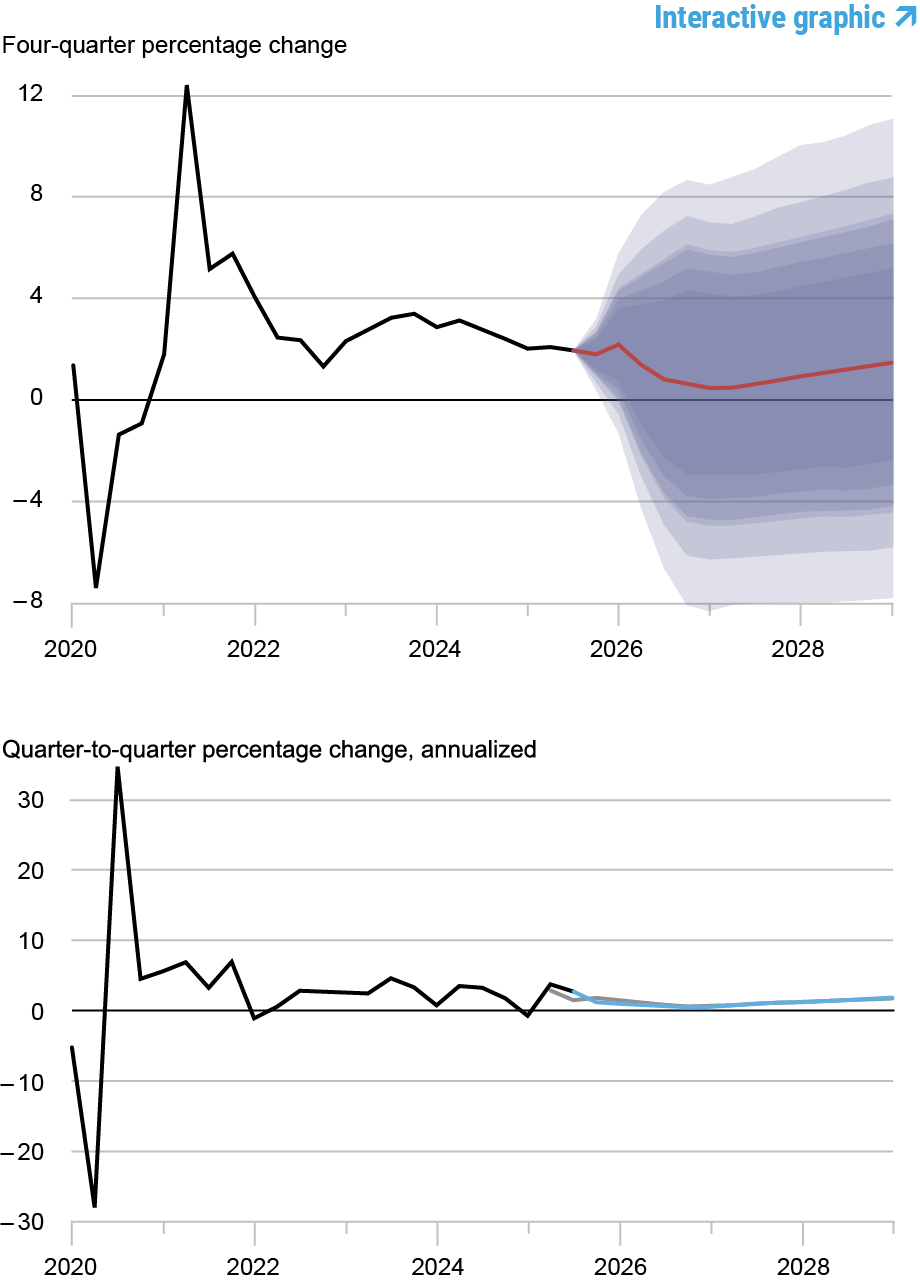
Notes: These two panels depict output growth. In the top panel, the black line indicates actual data and the red line shows the model forecasts. The shaded areas mark the uncertainty associated with our forecasts at 50, 60, 70, 80, and 90 percent probability intervals. In the bottom panel, the blue line shows the current forecast (quarter-to-quarter, annualized), and the gray line shows the September 2025 forecast.
Forecasts of Inflation
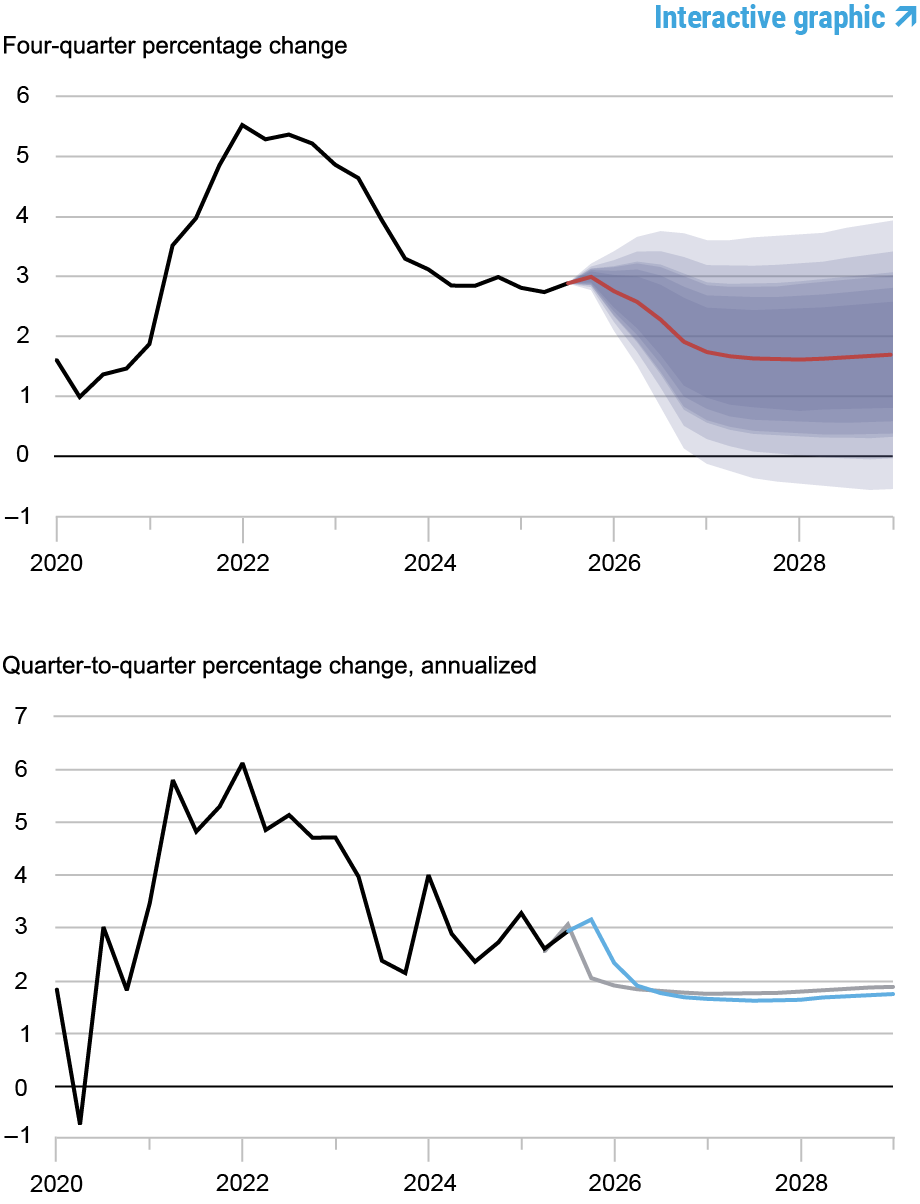
Notes: These two panels depict core personal consumption expenditures (PCE) inflation. In the top panel, the black line indicates actual data and the red line shows the model forecasts. The shaded areas mark the uncertainty associated with our forecasts at 50, 60, 70, 80, and 90 percent probability intervals. In the bottom panel, the blue line shows the current forecast (quarter-to-quarter, annualized), and the gray line shows the September 2025 forecast.
Real Natural Rate of Interest
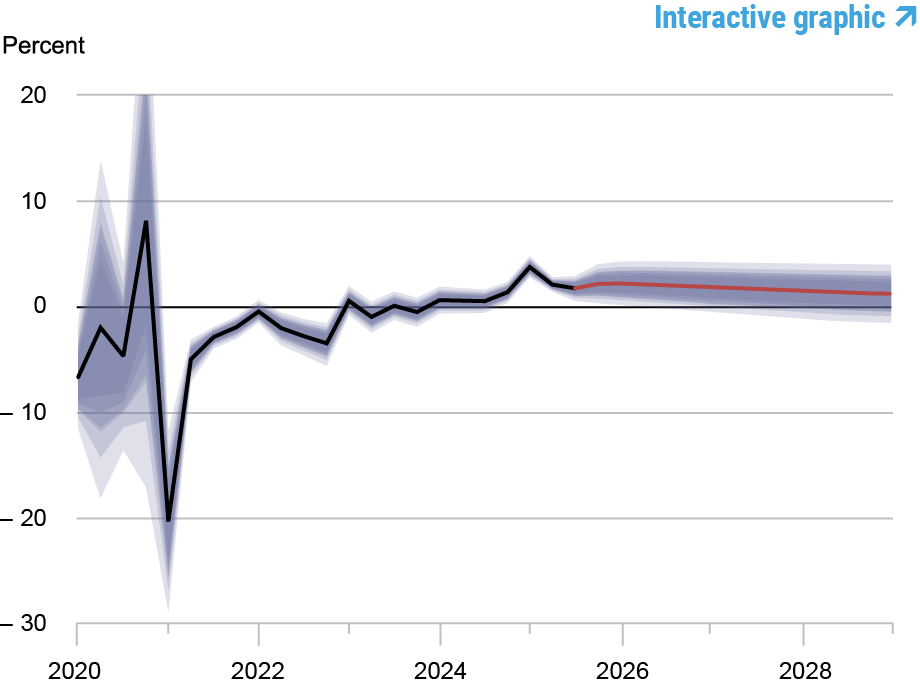
Notes: The black line shows the model’s mean estimate of the real natural rate of interest; the red line shows the model forecast of the real natural rate. The shaded area marks the uncertainty associated with the forecasts at 50, 60, 70, 80, and 90 percent probability intervals.

Marco Del Negro is an economic research advisor in the Federal Reserve Bank of New York’s Research and Statistics Group.

Ibrahima Diagne is a research analyst in the Federal Reserve Bank of New York’s Research and Statistics Group.

Keshav Dogra is an economic research advisor in the Federal Reserve Bank of New York’s Research and Statistics Group.

Elena Elbarmi is a research analyst in the Federal Reserve Bank of New York’s Research and Statistics Group.

Donggyu Lee is a research economist in the Federal Reserve Bank of New York’s Research and Statistics Group.

Michael Pham is a research analyst in the Federal Reserve Bank of New York’s Research and Statistics Group.
How to cite this post:
Marco Del Negro, Ibrahima Diagne, Keshav Dogra, Elena Elbarmi, Donggyu Lee, and Michael Pham, “The New York Fed DSGE Model Forecast— December 2025,” Federal Reserve Bank of New York Liberty Street Economics, December 12, 2025, https://libertystreeteconomics.newyorkfed.org/2025/12/the-new-york-fed-dsge-model-forecast-december-2025/
BibTeX: View |



Disclaimer
The views expressed in this post are those of the author(s) and do not necessarily reflect the position of the Federal Reserve Bank of New York or the Federal Reserve System. Any errors or omissions are the responsibility of the author(s).
 RSS Feed
 Follow Liberty Street Economics
