










4 posts on "K-Shaped Economy"
May 28, 2026
The Regional Side of the Story: K‑Shaped Pattern in Region, Wider Gap in Gas Spending

In this post, we use the inaugural release of our regional consumer spending indicators to ask whether these patterns hold for a significant portion of the Second District, and how regional spending patterns by income have been similar to or different from the national patterns we documented earlier. We find similar K‑shaped patterns in both retail and gas spending in our region as we do in the nation, with the K‑shaped pattern in gasoline in response to the recent gas price shock being more pronounced in the region.
May 6, 2026
Same Shock, Different Roads? A K‑Shaped Pattern at the Pump
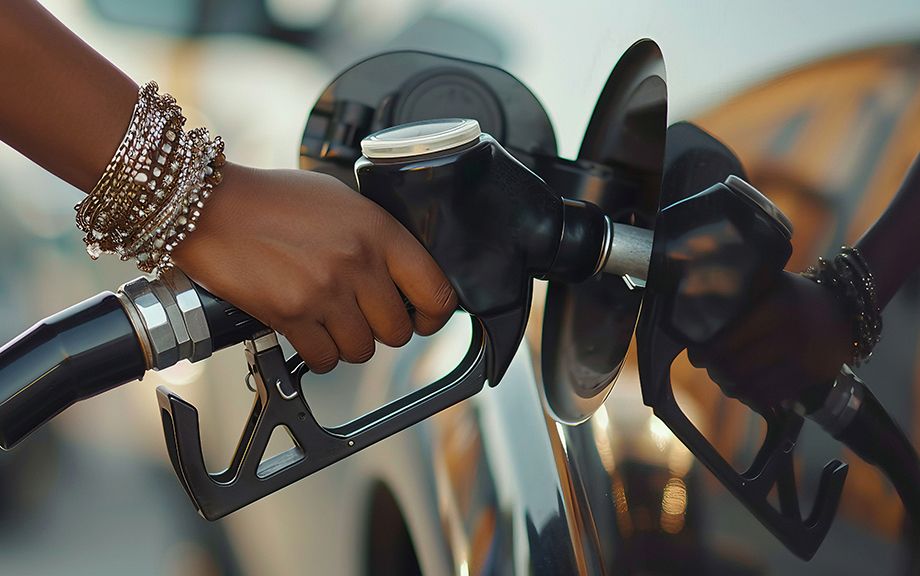
In March 2026, energy prices surged to a four-year high, driven by the Iranian closure of the Strait of Hormuz amid the ongoing conflict in the Middle East. In this Liberty Street Economics post, we use the new consumer spending module of the Economic Heterogeneity Indicators to analyze recent changes in nominal and real gas consumption across different income groups. We find that households had very different experiences with gasoline spending: in March, high-income households increased nominal spending the most and kept real consumption essentially unchanged, while low-income households decreased real consumption of gasoline but still saw sharply increased nominal spending because of the rise in gas prices. Therefore, with the sharp increases in gasoline prices in March, a K-shaped pattern in gasoline consumption emerged—showing faster consumption growth for high-income households relative to low-income households. These gasoline consumption patterns qualitatively match those following the increase in energy prices at the beginning of the Russia-Ukraine war in spring 2022, even though the gap in consumption trends during the current episode is quantitatively larger.
May 1, 2026
Explaining the K‑Shaped Economy: What’s Behind the Divide?

In our companion post, we used a new module of our Economic Heterogeneity Indicators (EHIs) to shed light on how recent retail spending growth has been driven by high-income households. This fact is consistent with the popular press’s idea of a “K-shaped economy” in which higher-income households experience faster growth in spending than lower-income households. In this post, we dive deeper into the reasons behind this divergence by analyzing for which goods this trend holds true and ask whether it can be explained by changes in wages, inflation, or wealth. We find that, since 2023, wealth has increased the most for high-income households, while inflation has risen the most for low-income households, with both factors helping explain the fact that real retail spending rose the most for high-income households. In contrast, earnings display a more mixed pattern, though earnings of the highest earners have grown more rapidly than earnings of the lowest earners.
Tracking the K‑Shaped Economy: Who’s Driving Spending?

Aggregate real consumer spending has risen solidly since 2023. However, it is less clear how widely shared this improvement has been across all segments of society. This is important because systematic heterogeneity may mask the dependence of aggregate growth on a relatively small group of households and thus conceal macroeconomic risks. In this post, we use consumer spending data recently added to the Economic Heterogeneity Indicators (EHIs) and find that retail spending growth has been driven by high-income households—those earning more than $125,000 per year. In the popular press, the phenomenon of higher-income households growing at a faster rate than lower-income households has been referred to as the K-shaped economy. We find that consumption has exhibited a K-shaped economy since 2023, although not in the pre-COVID period or during the post-COVID recovery.
Posted at 10:00 am in Household Finance, Inequality, K-Shaped Economy, Microeconomics | Permalink | Comments (3)
 RSS Feed
 Follow Liberty Street Economics
