










The March Survey of Consumer Expectations, which was fielded between March 2 and 31, records a substantial deterioration in financial and economic expectations, including sharp declines in household income and spending growth expectations.
Look for our next post on October 30.
April 6, 2020
How the Fed Managed the Treasury Yield Curve in the 1940s
The coronavirus pandemic has prompted the Federal Reserve to pledge to purchase Treasury securities and agency mortgage-backed securities in the amount needed to support the smooth market functioning and effective transmission of monetary policy to the economy. But some market participants have questioned whether something more might not be required, including possibly some form of direct yield curve control. In the first half of the 1940s the Federal Open Market Committee (FOMC) sought to manage the level and shape of the Treasury yield curve. In this post, we examine what can be learned from the FOMC’s efforts of seventy-five years ago.
Posted at 7:00 am in Economic History, Fed Funds, Federal Reserve, Fiscal Policy, Pandemic, Treasury | Permalink
April 2, 2020
The Value of Opacity in a Banking Crisis

During crisis periods, we often observe regulators limiting access to bank‑level information with the goal of restoring the public’s confidence in banks. Thus, information management often plays a central role in ending financial crises. Despite the perceived importance of managing information about individual banks during a financial crisis, we are not aware of any empirical work that quantifies the effect of such policies. In this blog post, we highlight results from our recent working paper, demonstrating that in a crisis, a policy of suppressing information about banks’ balance sheets has a significant and positive effect on deposits.
Posted at 7:00 am in Economic History, Financial Institutions, Financial Markets, Pandemic | Permalink
March 30, 2020
Monitoring Real Activity in Real Time: The Weekly Economic Index
New Weekly Economic Index sheds light on the high-frequency evolution of the economy in real time.
Businesses in the Tri‑State Region Struggling to Weather the Coronavirus Outbreak
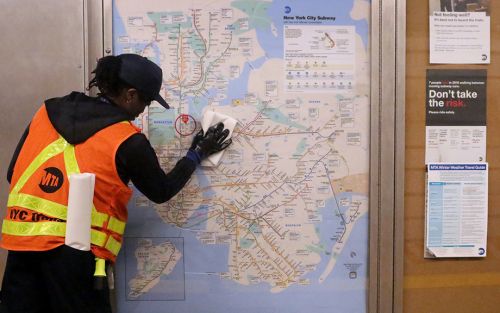
As a result of the coronavirus outbreak, New York State, New Jersey, and Connecticut have closed nonessential businesses and schools and asked residents to stay home in an effort to slow the spread of the virus. These actions are unprecedented, and the economic impacts are likely to be temporary but severe, and difficult to track and measure. With conditions changing so rapidly, timely data on the economic impacts of the outbreak and resultant policies on businesses and people are both scarce and important. In this post, we provide some very recent information on the economic effects of the coronavirus outbreak in the New York-Northern New Jersey region based on responses to a special survey we fielded between March 20 and March 24. The results are striking, though perhaps not surprising: roughly half of the service firms surveyed and well over a third of manufacturers said they have already implemented at least a partial temporary shutdown, and more firms plan to do so in the near future. Further, 40 percent of service firms and 30 percent of manufacturers are reporting staff reductions, and many firms are noting difficulty accessing credit and are concerned about their solvency.
March 27, 2020
Fight the Pandemic, Save the Economy: Lessons from the 1918 Flu
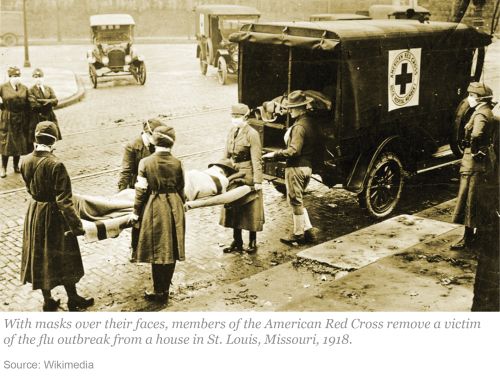
The COVID-19 outbreak has sparked urgent questions about the impact of pandemics, and the associated countermeasures, on the real economy. Policymakers are in uncharted territory, with little guidance on what the expected economic fallout will be and how the crisis should be managed. In this blog post, we use insights from a recent research paper to discuss two sets of questions. First, what are the real economic effects of a pandemic—and are these effects temporary or persistent? Second, how does the local public health response affect the economic severity of the pandemic? In particular, do non-pharmaceutical interventions (NPIs) such as social distancing have economic costs, or do policies that slow the spread of the pandemic also reduce its economic severity?
Posted at 5:18 pm in Balance of Payments, Crisis, Economic History, Pandemic, Recession | Permalink | Comments (3)
March 4, 2020
How Does Credit Access Affect Job‑Search Outcomes and Sorting?
The analysis considers how access to consumer credit influences the job search behavior of displaced workers.
Searching for Higher Job Satisfaction
Using data from the New York Fed’s Survey of Consumer Expectations, these Liberty Street Economics authors document the heterogeneity in job satisfaction among U.S. workers and in their preferences for various nonwage benefits, and discuss the impact of these preferences on job search behavior.
Is the Tide Lifting All Boats? A Closer Look at the Earnings Growth Experiences of U.S. Workers
Although there is evidence that U.S. workers at the bottom of the earnings distribution may be catching up with those at the top, there are indications that returns to higher education may be increasing, with earnings growth for college graduates outpacing those with less education.
Women Have Been Hit Hard by the Loss of Routine Jobs, Too
Jaison Abel and Richard Deitz find that although both men and women have experienced a loss of routine jobs since 2000, the decline has been markedly steeper for women.
 RSS Feed
 Follow Liberty Street Economics
