









Liberty Street Economics
Return to Liberty Street Economics Home Page

2 posts on "Financial Constraints"
April 13, 2026

What Millions of Homeowner’s Insurance Contracts Reveal About Risk Sharing
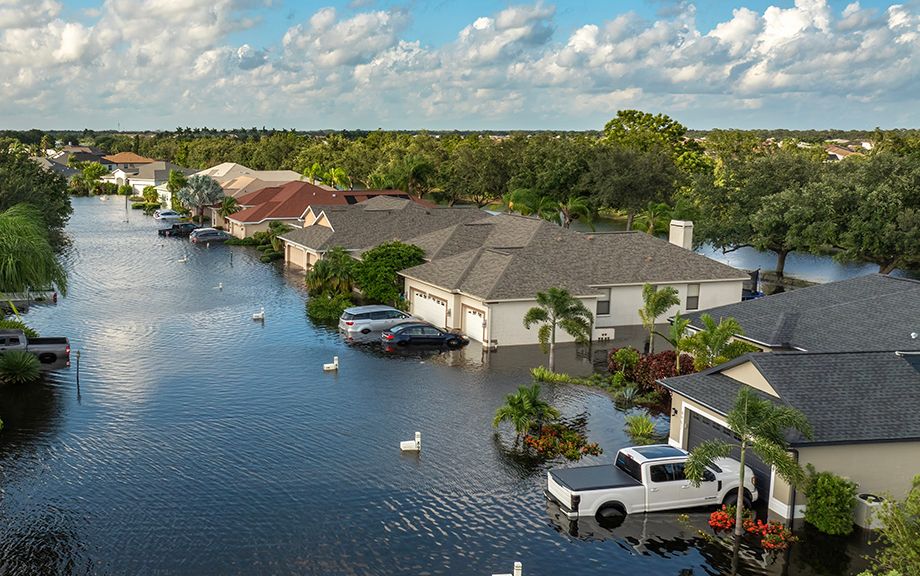
Hurricane Debby tropical rainstorm flooded residential homes and cars in suburban community in Sarasota, Florida. Aftermath of natural disaster.

Housing is the largest component of assets held by households in the United States, totaling $48 trillion in 2025. When natural disasters strike, the resulting damage to homes can be large relative to households’ liquid savings. Homeowner’s insurance is the primary financial tool households use to protect themselves against property risk. Despite the economic importance of homeowner’s insurance, we know surprisingly little about how insurance contracts are actually designed with respect to property risk. In this post, which is based on our new paper, Economics of Property Insurance,” we examine how homeowner’s insurance contracts are structured in practice. Using a new granular dataset covering millions of homeowner’s insurance policies, we document four striking patterns about coverage limits, deductibles, insurance pricing, and the distribution of property losses.

Posted at 7:00 am in Household Finance | Permalink
October 13, 2020

Weathering the Storm: Who Can Access Credit in a Pandemic?

Credit enables firms to weather temporary disruptions in their business that may impair their cash flow and limit their ability to meet commitments to suppliers and employees. The onset of the COVID recession sparked a massive increase in bank credit, largely driven by firms drawing on pre-committed credit lines. In this post, which is based on a recent Staff Report, we investigate which firms were able to tap into bank credit to help sustain their business over the ensuing downturn.

WATCH: Liberty Street Economics 15th Anniversary
About the Blog

Liberty Street Economics features insight and analysis from New York Fed economists working at the intersection of research and policy. Launched in 2011, the blog takes its name from the Bank’s headquarters at 33 Liberty Street in Manhattan’s Financial District.

The editors are Michael Fleming, Thomas Klitgaard, Maxim Pinkovskiy, and Asani Sarkar, all economists in the Bank’s Research Group.

Liberty Street Economics does not publish new posts during the blackout periods surrounding Federal Open Market Committee meetings.

The views expressed are those of the authors, and do not necessarily reflect the position of the New York Fed or the Federal Reserve System.

Economic Research Tracker

Image of NYFED Economic Research Tracker IconLiberty Street Economics is available on the iPhone® and iPad® and can be customized by economic research topic or economist.

Most Read this Year

Comment Guidelines


We encourage your comments and queries on our posts and will publish them (below the post) subject to the following guidelines:

Please be brief: Comments are limited to 1,500 characters.

Please be aware: Comments submitted shortly before or during the FOMC blackout may not be published until after the blackout.

Please be relevant: Comments are moderated and will not appear until they have been reviewed to ensure that they are substantive and clearly related to the topic of the post.

Please be respectful: We reserve the right not to post any comment, and will not post comments that are abusive, harassing, obscene, or commercial in nature. No notice will be given regarding whether a submission will or will
not be posted.‎

Comments with links: Please do not include any links in your comment, even if you feel the links will contribute to the discussion. Comments with links will not be posted.

Send Us Feedback

Disclosure Policy

The LSE editors ask authors submitting a post to the blog to confirm that they have no conflicts of interest as defined by the American Economic Association in its Disclosure Policy. If an author has sources of financial support or other interests that could be perceived as influencing the research presented in the post, we disclose that fact in a statement prepared by the author and appended to the author information at the end of the post. If the author has no such interests to disclose, no statement is provided. Note, however, that we do indicate in all cases if a data vendor or other party has a right to review a post.

Archives
