











The rapid spread of generative AI (AI) tools is reshaping the workplace at a remarkable rate. Yet relatively little is known about whether workers have access to these tools, how the tools affect workers’ daily productivity, and how much workers value the training needed to use the tools effectively. In this post, we shed light on these issues by drawing on supplemental questions in the November 2025 Survey of Consumer Expectations (SCE), fielded to a representative sample of the U.S. population. We find that adoption of AI tools at work is heterogeneous, that a sizable share of workers see AI training as important, and that a significant share of employers are nonetheless not yet providing access to AI tools or training on how to use them.
Who Is Using AI at Work?
Among currently employed respondents, 39 percent report that they are either using AI tools in their current job or have used AI tools in their jobs in the last twelve months. This statistic, however, masks wide variation across demographic groups. As shown in the chart below, college graduates are more than twice as likely to have used AI tools at work in the past twelve months as those without a college degree (58.7 percent versus 22.9 percent). The usage difference across income groups is equally pronounced: AI adoption rises from 15.9 percent among workers earning under $50,000 to 66.3 percent among those earning over $200,000 annually. And full-time workers are considerably more likely to use AI than part-time workers (42.7 percent versus 24.7 percent). Taken together, these patterns suggest that AI adoption at work currently favors higher-income, higher-educated, and full-time workers. This finding raises questions about whether AI may widen rather than narrow existing labor market inequalities.
AI Use in the Workplace Is Concentrated Among Higher-Income, Higher-Educated, and Full-Time Workers
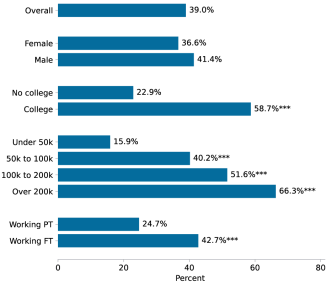
Notes: The chart shows the share of respondents reporting AI use in their current jobs in the past twelve months. The differences in AI usage shares across groups are tested against the first group for each category. The significance levels are denoted as follows: * 10 percent, ** 5 percent, *** 1 percent.
When we focus on workers who have used AI tools in the past twelve months in their current workplace, about 66 percent report that these tools increase their own personal productivity. Looking specifically at how using AI tools is related to their own productivity, 40 percent said that the tools help them finish tasks faster and 22 percent report that the tools enable them to complete more tasks overall. At the same time, 19 percent report that they are still learning to use AI and, therefore, tasks actually take longer. However, barriers to adoption also remain significant, as 37 percent of employed respondents say their workplace does not offer AI tools, and an additional 11 percent say their employer actively prohibits their use.
Are Workers Ready to Use AI Tools at Work?
Although most workers with access to AI tools recognize the productivity-enhancing impacts of AI, training in AI tools is not available to all of them. Around 38 percent of employed respondents said that having training in how to use AI tools is important to them, yet only 15.9 percent report that their employer currently offers any AI training.
Employed respondents who value training in using AI tools are particularly likely to emphasize near-term on-the-job benefits as reasons why they find such training useful: 68.0 percent cite making their job easier and 56.7 percent cite increased productivity, as shown in the chart below. Furthermore, 39.2 percent cite that there won’t be many jobs that don’t use AI in the future. Among the roughly 60 percent of employed respondents who do not consider AI training important, the most common reason is simply that they do not expect to use AI in their jobs (48.5 percent). Other commonly cited reasons include not thinking AI will change their industry (21.1 percent) and not thinking training is required or useful for using AI tools at work (19.6 percent).
Workers Find Training in Using AI Tools Important for Near-Term On-The-Job Benefits
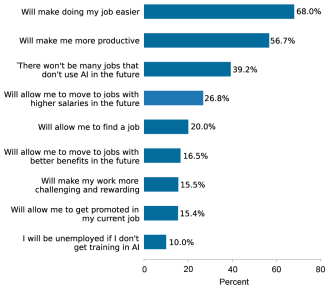
Notes: The chart shows the share of respondents choosing each reason for why they find training in AI tools important. The sample for the chart only includes respondents who stated they find training in AI tools useful.
What Is the Worth of AI Training?
To elicit the monetary value that workers attach to having access to training in AI tools, we asked workers without access to employer-provided AI training what percentage of their salary they would be willing to give up for an otherwise identical job that offers extensive AI training. Workers who already have access to employer-sponsored training were asked the reverse: what salary increase they would require to accept an otherwise identical job that offers no AI training.
Among workers who currently lack access to training, the average willingness to pay (WTP) for gaining this access is 11.4 percent of current salary. However, the distribution is highly skewed: the median response is 0, meaning that a large share of workers are unwilling to accept any pay cut for training (see left panel of chart below). Around 61 percent of respondents who lack access to AI training have 0 WTP for training in AI tools. Yet, among those who do assign positive value, the amounts are often substantial. Around 20 percent of workers who lack access to training have a WTP between 0 and 10 percent of their current salaries, and 19 percent have a WTP larger than 10 percent.
Workers’ Who Have Access to AI Training Value It More Than Workers Who Don’t
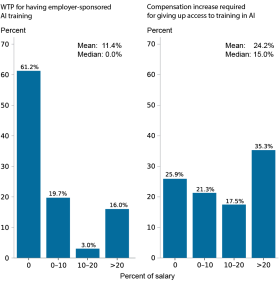
The picture is notably different for workers who already have access to training. On average, these workers report that they would require a 24.2 percent salary increase to accept an otherwise identical job that doesn’t offer access to any AI training, with a median of 15 percent (see chart above, right panel). Around 26 percent of workers with access to AI training do not need any salary increase, 21 percent need between 0 and 10 percent additional salary, and 53 percent need more than 10 percent to move to a similar job without employer-provided AI training. (Note that the fact that their employers provide access to AI training does not necessarily mean that these workers have already received AI training or that they are confident in their skills to use AI tools.)
The large gap between the average compensation needed to give up access to training (24.2 percent) and the average WTP to gain access (11.4 percent) may also reflect patterns of loss aversion: once a benefit is part of an existing job package, people demand considerably more to surrender it than they would be willing to pay to obtain it. This is consistent with findings on the willingness to pay for workplace benefits in general, suggesting that workers sort into jobs based on their preferences for non-wage workplace benefits.
This difference in WTPs may also reflect selection: AI tools are considered more valuable in jobs or industries that provide training in how to use them effectively.
Workers’ WTP for access to training in the use of AI tools varies across worker characteristics. In particular, younger workers, non-white workers, those without a college degree, and those with less than one year of job tenure express significantly higher willingness to pay for having access to training in AI skills. On the other side of the trade-off, full-time workers and those without a college degree require a significantly larger salary premium to accept a job that does not offer access to training in AI tools.
Expectations About AI’s Effects on the Labor Market
Our data also capture respondents’ expectations on how access to AI tools will alter the labor market. Around 62 percent of all respondents believe the unemployment rate will increase over the next twelve months due to AI, while around 11.6 percent expect it will decrease due to AI.
Wrapping Up
The November 2025 SCE results document that AI tools are already in meaningful workplace use, but that adoption is heavily concentrated among higher-income, higher-educated, and full-time workers. A sizable share of workers value having training in how to use AI tools. However, employer provision of training remains limited. Crucially, some of the workers who place the highest value on AI training, such as those without a college degree, are also those with the lowest rates of AI usage and the lowest share of access to employer-provided training in how to use AI tools. Closing this gap may be essential to reaching the productivity gains from having generative AI tools in the workplace.
Ali Hashim is a research analyst in the Federal Reserve Bank of New York’s Research and Statistics Group.

Gizem Kosar is an economic research advisor in the Federal Reserve Bank of New York’s Research and Statistics Group.

Wilbert van der Klaauw is an economic research advisor in the Federal Reserve Bank of New York’s Research and Statistics Group.
How to cite this post:
Ali Hashim, Gizem Kosar, and Wilbert van der Klaauw, “Use of Gen AI in the Workplace and the Value of Access to Training,” Federal Reserve Bank of New York Liberty Street Economics, April 14, 2026, https://doi.org/10.59576/lse.20260414
BibTeX: View |



Disclaimer
The views expressed in this post are those of the author(s) and do not necessarily reflect the position of the Federal Reserve Bank of New York or the Federal Reserve System. Any errors or omissions are the responsibility of the author(s).
 RSS Feed
 Follow Liberty Street Economics
