










232 posts on "Household Finance"
August 13, 2020
The Disproportionate Effects of COVID‑19 on Households with Children

A growing body of evidence (here, here, and here) points to large negative economic and health impacts of the COVID-19 pandemic on low-income, Black, and Hispanic Americans. Beyond the consequences of school cancellations and lost social interactions, there exists considerable concern about the long-lasting effects of economic hardship on children. In this post, we assess the extent of the underlying economic and financial strain faced by households with children living at home, using newly collected data from the monthly Survey of Consumer Expectations (SCE).
August 6, 2020
A Monthly Peek into Americans’ Credit During the COVID‑19 Pandemic

Total household debt was roughly flat in the second quarter of 2020, according to the latest Quarterly Report on Household Debt and Credit from the New York Fed’s Center for Microeconomic Data. But, for the first time, the dynamics in household debt balances were driven primarily by a sharp decline in credit card balances, as consumer spending plummeted. In an effort to gain greater clarity, the New York Fed and the Federal Reserve System have acquired monthly updates for the New York Fed Consumer Credit Panel, based on anonymized Equifax credit report data. We’ve been closely watching the data as they roll in, and here we present six key takeaways on the consumer balance sheet in the months since COVID-19 hit.
July 8, 2020
Medicare and Financial Health across the United States
Consumer financial strain varies enormously across the United States. One pernicious source of financial strain is debt in collections—debt that is more than 120 days past due and that has been sold to a collections agency. In Massachusetts, the average person has less than $100 in collections debt, while in Texas, the average person has more than $300. In this post, we discuss our recent staff report that exploits the fact that virtually all Americans are universally covered by Medicare at 65 to show that health insurance not only improves financial health on average, but also is a major explanation for the heterogeneity in financial strain across the country. We find that Medicare affects different parts of the United States differently and plays a particularly important role in improving financial health in the least advantaged areas.
Do College Tuition Subsidies Boost Spending and Reduce Debt? Impacts by Income and Race
In an October post, we showed the effect of college tuition subsidies in the form of merit-based financial aid on educational and student debt outcomes, documenting a large decline in student debt for those eligible for merit aid. Additionally, we reported striking differences in these outcomes by demographics, as proxied by neighborhood race and income. In this follow-up post, we examine whether and how this effect passes through to other debt and consumption outcomes, namely those related to autos, homes, and credit cards. We find that access to merit aid leads to an immediate but temporary increase in eligible individuals’ consumption in these categories. The increase is followed by a decline in consumption and a reduction in total debt of these types in the longer term. Importantly, there are marked differences in these consumption and debt patterns across groups, as evident when we introduce proxies for demographic group using the income and racial composition of the students’ home neighborhoods of origin.
Measuring Racial Disparities in Higher Education and Student Debt Outcomes
Across the United States, the cost of all types of higher education has been rising faster than overall inflation for more than two decades. Despite rising costs, aggregate undergraduate enrollment rose steadily between 2000 and 2010 before leveling off and dipping slightly to its current level. Rising college costs have steadily increased dependence on student debt for college financing, with many students and parents turning to federal and private loans to pay for higher education. An earlier post in this series reported that borrowers in majority Black areas have higher student loan balances and rates of default than those in both majority white and majority Hispanic areas. In this post, we study how differences in college attendance rates and in the types of colleges attended generate heterogeneity in loan experiences. Specifically, using nationwide data, we analyze heterogeneities in college-going and heterogeneities in student debt and default experiences by college type across individuals living in majority Black, majority Hispanic, and majority white zip codes.
Posted at 7:30 am in Education, Equitable Growth, Household Finance, Inequality, Student Loans | Permalink
Inequality in U.S. Homeownership Rates by Race and Ethnicity
Homeownership has historically been an important means for Americans to accumulate wealth—in fact, at more than $15 trillion, housing equity accounts for 16 percent of total U.S. household wealth. Consequently, the U.S. homeownership cycle has triggered large swings in Americans’ net worth over the past twenty-five years. However, the nature of those swings has varied significantly by race and ethnicity, with different demographic groups tracing distinct trajectories through the housing boom, the foreclosure crisis, and the subsequent recovery. Here, we look into the dynamics underlying these divergences and explore some potential explanations.
July 7, 2020
Introduction to Heterogeneity Series III: Credit Market Outcomes
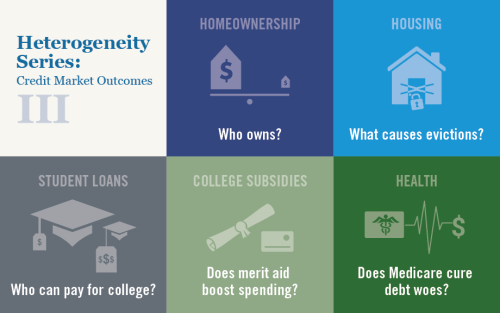
Following up series on heterogeneity and inequality broadly and in labor market outcomes specifically, we turn our focus to further documenting heterogeneity in credit market outcomes, looking at disparities in home ownership rates, varying exposure to evictions, differing gains from tuition support and Medicare programs, and more.
May 7, 2020
Amid the COVID‑19 Outbreak, Consumers Temper Spending Outlook

The New York Fed’s Center for Microeconomic Data released results today from its April 2020 SCE Household Spending Survey, which provides information on consumers’ experiences and expectations regarding household spending. These data have been collected every four months since December 2014 as part of our Survey of Consumer Expectations (SCE). Given the ongoing COVID-19 outbreak, the April survey, which was fielded between April 2 and 30, unsurprisingly shows a number of sharp changes in consumers’ spending behavior and outlook, which we review in this post.
May 5, 2020
U.S. Consumer Debt Payments and Credit Buffers on the Eve of COVID‑19
Today, the New York Fed’s Center for Microeconomic Data released the Quarterly Report on Household Debt and Credit for 2020:Q1. Because consumer debt servicing statements are typically furnished to credit bureaus only once during every statement period, our snapshot of consumer credit reports as of March 31, 2020 is, in effect, a pre-COVID-19 view of the consumer balance sheet. While significant indications of the pandemic are yet to appear in our Consumer Credit Panel (CCP—the data source for the Quarterly Report, based on Equifax credit reports), we are able to observe the credit position of the American consumer just as the pandemic and associated lockdowns struck the United States.
Posted at 11:00 am in Household Finance | Permalink
April 16, 2020
How Widespread Is the Impact of the COVID‑19 Outbreak on Consumer Expectations?

In a recent blog post, we showed that consumer expectations worsened sharply through March, as the COVID-19 epidemic spread and affected a growing part of the U.S. population. In this post, we document how much of this deterioration can be directly attributed to the coronavirus outbreak. We then explore how the effect of the outbreak has varied over time and across demographic groups.
 RSS Feed
 Follow Liberty Street Economics
