The risk of becoming unemployed varies substantially across different groups within the labor market.
At the New York Fed, our mission is to make the U.S. economy stronger and the financial system more stable for all segments of society. We do this by executing monetary policy, providing financial services, supervising banks and conducting research and providing expertise on issues that impact the nation and communities we serve.
Fatih Karahan
Fatih Karahan How much someone earns is an important determinant of many significant decisions over the course of a lifetime. Therefore, understanding how and why earnings are dispersed across individuals is central to understanding dispersion in a wide range of areas such as durable and non-durable consumption expenditures, debt, hours worked, and even health. Drawing […]
Ayşegül Şahin
The Federal Reserve’s statutory mission from Congress is to achieve maximum employment and price stability for the country as a whole.
Robert DeYoung, Ronald J. Mann, Donald P. Morgan, and Michael R. Strain
Except for the ten to twelve million people who use them every year, just about everybody hates payday loans.
Jacob Adenbaum, Antoine Martin, and Susan McLaughlin
The tri-party repo market is a large and important market where securities dealers find a substantial amount of short-term funding. Despite its importance, this market was very opaque before the crisis. Since March 2010, in accordance with recommendation 13 of the Task Force on Tri-Party Repo Infrastructure Reform report, the Federal Reserve Bank of New York has made monthly data on the tri-party repo market available to the public. Today, with our new interactive tool, there is a whole new way to view the market and its evolution. You can make your own charts, looking at volumes for specific asset classes, at haircuts, or at concentration, over your preferred time horizon.
Jason Bram and Richard Deitz
The October 2015 Business Leaders Survey of regional service firms, released today, paints a considerably more benign picture of local business conditions than the more troubling October 2015 Empire State Manufacturing Survey, released yesterday.
Amy Farber
You might think that, given the extreme levels of wealth that exist today, the richest economist would be someone who was still alive. But you’d be wrong.
W. Scott Frame, Andreas Fuster, Joseph Tracy, and James Vickery
In September 2008, the U.S. government engineered a dramatic rescue of Fannie Mae and Freddie Mac, placing the two firms into conservatorship and committing billions of taxpayer dollars to stabilize their financial position.
Michael J. Fleming and Collin Jones
Michael J. Fleming and Collin Jones The aftermath of the financial crisis and changes in technology and regulation have spurred a spirited discussion of dealers’ evolving role in financial markets. One such role is to buy securities at auction and sell them off to investors over time. We assess this function using data on primary […]
Dobrislav Dobrev and Ernst Schaumburg
Market efficiency is often pointed to as a main benefit of automated and high-frequency trading (HFT) in U.S. Treasury markets.
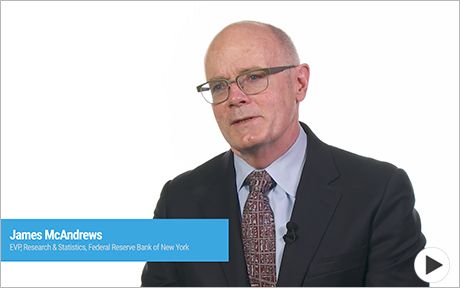
“What’s really driving inflation?” “Why do some neighborhoods bounce back faster than others?” Meet some of the New York Fed researchers working to answer questions that matter most to the economy.
Liberty Street Economics features insight and analysis from New York Fed economists working at the intersection of research and policy. Launched in 2011, the blog takes its name from the Bank’s headquarters at 33 Liberty Street in Manhattan’s Financial District.
The editors are Michael Fleming, Thomas Klitgaard, Maxim Pinkovskiy, and Asani Sarkar, all economists in the Bank’s Research Group.
Liberty Street Economics does not publish new posts during the blackout periods surrounding Federal Open Market Committee meetings.
The views expressed are those of the authors, and do not necessarily reflect the position of the New York Fed or the Federal Reserve System.
We encourage your comments and queries on our posts and will publish them (below the post) subject to the following guidelines:
Please be brief: Comments are limited to 1,500 characters.
Please be aware: Comments submitted shortly before or during the FOMC blackout may not be published until after the blackout.
Please be relevant: Comments are moderated and will not appear until they have been reviewed to ensure that they are substantive and clearly related to the topic of the post.
Please be respectful: We reserve the right not to post any comment, and will not post comments that are abusive, harassing, obscene, or commercial in nature. No notice will be given regarding whether a submission will or will
not be posted.
Comments with links: Please do not include any links in your comment, even if you feel the links will contribute to the discussion. Comments with links will not be posted.
The LSE editors ask authors submitting a post to the blog to confirm that they have no conflicts of interest as defined by the American Economic Association in its Disclosure Policy. If an author has sources of financial support or other interests that could be perceived as influencing the research presented in the post, we disclose that fact in a statement prepared by the author and appended to the author information at the end of the post. If the author has no such interests to disclose, no statement is provided. Note, however, that we do indicate in all cases if a data vendor or other party has a right to review a post.