










393 posts on "Liberty Street Economics"
April 11, 2022
The Fed’s Balance Sheet Runoff and the ON RRP Facility

A 2017 Liberty Street Economics post described the balance sheet effects of the Federal Open Market Committee’s decision to cease reinvestments of maturing securities—that is, the mechanics of the Federal Reserve’s balance sheet “runoff.” At the time, the overnight reverse repo (ON RRP) facility was fairly small (less than $200 billion for most of July 2017) and was not mentioned in the post for the sake of simplicity. Today, by contrast, take-up at the ON RRP facility is much larger (over $1.5 trillion for most of 2022). In this post, we update the earlier analysis and describe how the presence of the ON RRP facility affects the mechanics of the balance sheet runoff.
Posted at 7:00 am in Central Bank, COVID-19 Facilities, Federal Reserve, Monetary Policy, Repo | Permalink | Comments (3)
April 4, 2022
Climate Change and Financial Stability: The Weather Channel

Climate change could affect banks and the financial systems they anchor through various channels: increasingly extreme weather is one (Financial Stability Board, Basel Committee on Bank Supervision). In our recent staff report, we size up this channel by studying how U.S. banks, large and small, fared against disasters past. We find even the most destructive disasters had insignificant or small effects on bank stability and small and positive effects on bank income. We conjecture that recovery lending after disasters helps stabilize larger banks while smaller, local banks’ knowledge of “unmarked” (flood) hazards may help them navigate disaster risk. Federal disaster aid seems not to act as a bank stabilizer.
March 30, 2022
How Have the Euro Area and U.S. Labor Market Recoveries Differed?

The initial phase of the pandemic saw the euro area and U.S unemployment rates behave quite differently, with the rate for the United States rising much more dramatically than the euro area rate. Two years on, the rates for both regions are back near pre-pandemic levels. A key difference, though, is that U.S. employment levels were down by 3.0 million jobs in 2021:Q4 relative to pre-pandemic levels, while the number of euro area jobs was up 600,000. A look at employment by industry shows that both regions had large shortfalls in the accommodation and food services industries, as expected. A key difference is the government sector, with the number of those jobs in the euro area up by 1.5 million, while the government sector in the United States shed 600,000.
March 22, 2022
Student Loan Repayment during the Pandemic Forbearance

The onset of the COVID-19 pandemic brought substantial financial uncertainty for many Americans. In response, executive and legislative actions in March and April 2020 provided unprecedented debt relief by temporarily lowering interest rates on Direct federal student loans to 0 percent and automatically placing these loans into administrative forbearance. As a result, nearly 37 million borrowers have not been required to make payments on their student loans since March 2020, resulting in an estimated $195 billion worth of waived payments through April 2022. However, 10 million borrowers with private loans or Family Federal Education Loan (FFEL) loans owned by commercial banks were not granted the same relief and continued to make payments during the pandemic. Data show that Direct federal borrowers slowed their paydown, with very few making voluntary payments on their loans. FFEL borrowers, who were not covered by the automatic forbearance, struggled with their debt payments during this time. The difficulties faced by these borrowers in managing their student loans and other debts suggest that Direct borrowers will face rising delinquencies once forbearance ends and payments resume.
March 18, 2022
The New York Fed DSGE Model Forecast—March 2022

This post presents an update of the economic forecasts generated by the Federal Reserve Bank of New York’s dynamic stochastic general equilibrium (DSGE) model. We describe very briefly our forecast and its change since December 2021. As usual, we wish to remind our readers that the DSGE model forecast is not an official New York Fed forecast, but only an input to the Research staff’s overall forecasting process. For more information about the model and variables discussed here, see our DSGE model Q & A.
March 3, 2022
Global Supply Chain Pressure Index: March 2022 Update

Supply chain disruptions continue to be a major challenge as the world economy recovers from the COVID-19 pandemic. In a January post, we presented the Global Supply Chain Pressure Index (GSCPI) as a parsimonious global measure that encompasses several indicators used to capture supply chain disruptions. The main purpose of this post is to provide an update of the GSCPI through February 2022. In addition, we use the index’s underlying data to discuss the drivers of recent moves in the GSCPI. Finally, these data are used to create country-specific supply chain pressures indices.
March 2, 2022
Disinflation Policies with a Flat Phillips Curve

Yesterday’s post analyzed the drivers of the surge in inflation over the course of 2021 through the lens of the New York Fed DSGE model. In today’s post, we use the model to study how alternative monetary policy strategies might contribute to bringing inflation back down to 2 percent. Our main finding is that there is no monetary silver bullet. Due to a flat Phillips curve—a well–documented feature of the economic environment of the last three decades—monetary policy can only achieve faster disinflation at a considerable cost in terms of forgone economic activity. This is true regardless of the systematic approach followed by the central bank in the model to pursue its objective.
March 1, 2022
Drivers of Inflation: The New York Fed DSGE Model’s Perspective

After a sharp decline in the first few months of the COVID-19 pandemic, inflation rebounded in the second half of 2020 and surged through 2021. This post analyzes the drivers of these developments through the lens of the New York Fed DSGE model. Its main finding is that the recent rise in inflation is mostly accounted for by a large cost-push shock that occurred in the second quarter of 2021 and whose inflationary effects persist today. Based on the model’s reading of historical data, this shock is expected to fade gradually over the course of 2022, returning quarterly inflation to close to 2 percent only in mid-2023.
February 17, 2022
How (Un‑)Informed Are Depositors in a Banking Panic? A Lesson from History
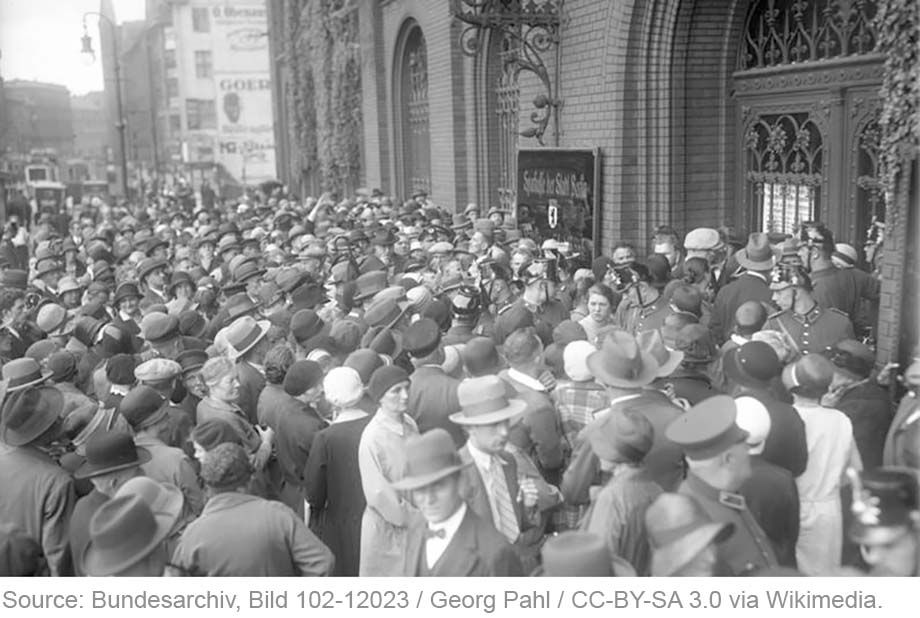
How informed or uninformed are bank depositors in a banking crisis? Can depositors anticipate which banks will fail? Understanding the behavior of depositors in financial crises is key to evaluating the policy measures, such as deposit insurance, designed to prevent them. But this is difficult in modern settings. The fact that bank runs are rare and deposit insurance universal implies that it is rare to be able to observe how depositors would behave in absence of the policy. Hence, as empiricists, we are lacking the counterfactual of depositor behavior during a run that is undistorted by the policy. In this blog post and the staff report on which it is based, we go back in history and study a bank run that took place in Germany in 1931 in the absence of deposit insurance for insight.
Posted at 7:00 am in Banks, Financial Institutions, Financial Intermediation, Panic, Systemic Risk | Permalink
February 16, 2022
The Omicron Wave Stalled Growth and Led to High Absenteeism in the Region

Even before the start of the new year, businesses in the tri-state region were hampered by supply disruptions, rising input costs, and difficulty finding adequate staff. On top of these challenges, the Omicron wave dealt another setback to the regional economy. With infections running high, many businesses were forced to deal with a combination of reduced demand from customers and renewed absenteeism among workers. Indeed, our regional business surveys indicate that economic growth stalled in early 2022 as firms continued to struggle to find workers. Moreover, employee absenteeism was reported to be nearly three times its normal level. While the path of recovery remains highly uncertain, firms generally expect conditions to improve in the months ahead and many are still adding or planning to add staff.
 RSS Feed
 Follow Liberty Street Economics
