










The ongoing advancement and adoption of artificial intelligence continues to raise concerns about widespread job losses. Over the past three years, our regional business surveys have asked firms about their AI adoption and its effects on their workforces. This year, we found that AI use among regional businesses has continued to rise sharply, with more than 60 percent of service firms and about half of manufacturers now using AI—a notable increase from 40 percent and 26 percent, respectively, reported in 2025. Despite this rapid adoption, regional firms’ investments in AI are generally modest, usage tends to be concentrated among a small share of workers within firms, and layoffs have remained uncommon. And, while some firms have scaled back hiring due to AI, others have added workers to help them use it. Retraining employees in response to AI remains the primary way firms are adjusting their workforces.
AI Adoption Has Become Much More Widespread in the Workplace
Our August business surveys asked firms in the New York and Northern New Jersey region whether they used AI as part of their business processes in the past six months, questions we have asked each year since 2024. AI adoption in the workplace has continued to increase sharply and has now become widespread. As shown in the chart below, 61 percent of service firms reported using AI this year, up from 40 percent last year and 25 percent in 2024. Businesses in knowledge-intensive sectors, such as information, business services, and finance, had the highest usage rates. Among manufacturers, 51 percent reported using AI as part of their business processes, roughly double the 26 percent from last year and triple the 16 percent in 2024. These shares are toward the high end of the range of existing studies of AI use in the workplace.
AI Adoption Has Continued to Increase
Percent
Note: Firms using AI exclusively as an information search tool but nothing else were not counted as AI users.
While AI adoption has become widespread, most firms have made only limited investments in the technology. Three-quarters of service firms and more than 90 percent of manufacturers characterize their AI investments as minimal to modest, ranging from use of free AI tools to allocating a small share of overall spending to AI tools or services. Meanwhile, just 15 percent of service firms—but no manufacturers—indicate they have committed significant resources to AI adoption, with only about 5 percent of service firms characterizing AI adoption as a major strategic investment. Among AI adopters, the median share of workers using it was just 17 percent for service firms and 7 percent for manufacturers. In short, AI adoption in the workplace is now fairly broad but investments and worker usage remain limited.
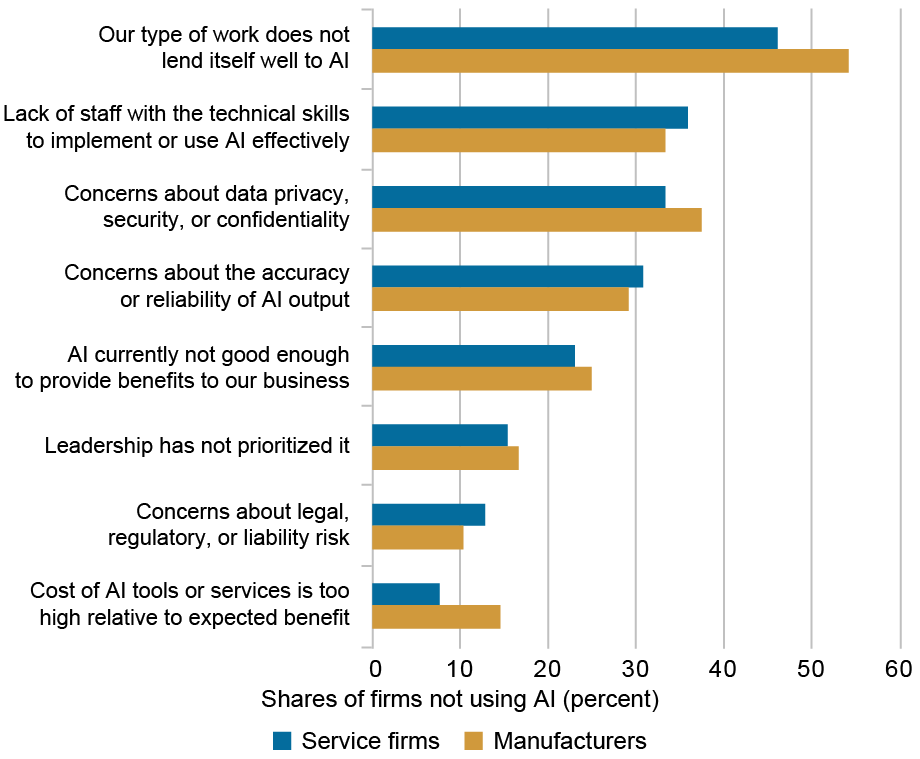
With AI use in the workplace now widespread, why have some businesses refrained from adopting it? As shown in the chart below, cost does not seem to be the main deterrent—it was among the least cited reasons by non-adopters. About half of non-adopters said the type of work they do does not lend itself to AI, while roughly a quarter indicated AI is currently not good enough to provide benefits to their business. There were also some concerns about using AI. More than a third of non-adopters were concerned about data privacy, security, or confidentiality, and a similar share expressed concerns about accuracy or reliability. Further, roughly a third indicated they currently lack staff with the technical skills to use it effectively.
Why Businesses Have Not Adopted AI
Retraining Remains Common, Layoffs Limited
As in past years, we asked firms if they were making any changes to their workforces as a result of AI adoption, as shown in the chart below. Only 4 percent of service firms reported laying off workers in response to AI over the past six months, compared to just 1 percent in last year’s survey, while no manufacturers reported layoffs this year or last year. About 15 percent of service firms said they had hired fewer workers than they would have if not for AI use, similar to the 12 percent reported last year. A handful of manufacturers reported hiring fewer workers due to AI, compared to none last year.
However, offsetting these reductions in hiring, some firms added workers to help them leverage AI. About 13 percent of service firms said they had hired more workers due to AI, similar to last year’s findings, though no manufacturers increased hiring due to AI this year.
Ways Service Firms Are Adjusting Their Workforces
Share of AI users (percent)
Ways Manufacturers Are Adjusting Their Workforces
Share of AI users (percent)
Note: Firms were not asked whether they hired fewer workers in 2024.
Consistent with our earlier surveys, existing workers are much more likely to be retrained than replaced by AI. Among businesses that use AI, just over a third of service firms and more than 20 percent of manufacturing firms report retraining workers in response to AI. Firms report retraining workers across the educational spectrum, though somewhat more of those with college degrees.
These findings align with the broader research literature, which also tends to find limited labor market effects from AI adoption so far in terms of layoffs or reduced hiring. However, one recent study suggests entry-level workers may be affected significantly, as AI can substitute for routine tasks often performed by newer employees, potentially creating barriers to workforce entry even as it enhances productivity for experienced workers.
How Are Businesses Retraining Workers?
Given the importance of retraining workers to use AI, we asked businesses about the kinds of retraining they have provided. Responses indicate that most firms are focused on helping employees do their current jobs more effectively rather than preparing them for entirely new roles. Training falls into several key categories: basic AI literacy and tool-specific instruction (such as learning to use chatbots, AI assistants, or other generative AI tools), how to automate repetitive or routine tasks, prompt engineering to get better results from AI systems, and using AI applications tailored to specific job functions. For example, some firms are training employees to use AI for marketing and creating social media content, while one firm had implemented AI for accounts payable and receivable with “human-in-the-loop” oversight.
Notably, many companies emphasized the importance of training employees on responsible AI use, including teaching them how to verify AI outputs, understand potential biases, follow data security protocols, and avoid over-reliance on the technology. Delivery methods varied widely, from formal workshops and external consultants to informal show-and-tell sessions and peer learning, with many organizations encouraging experimentation and hands-on practice.
Looking Ahead
Three years of data from our regional business surveys suggest firms are continuing to adapt and change due to AI use, but not by eliminating vast numbers of jobs. Instead, this new technology is reshaping work itself, with firms investing in their existing workforces rather than replacing large swaths of people. As AI adoption becomes the norm rather than the exception, retraining has only gained in importance. Evidence from our surveys so far confirms what many studies are showing: that AI has been more likely to augment workers than replace them. That said, AI technology and its applications are still evolving rapidly, and these patterns could shift as adoption matures.

Jaison R. Abel is head of Microeconomics in the Federal Reserve Bank of New York’s Research and Statistics Group.

Richard Deitz is an economic policy advisor in the Federal Reserve Bank of New York’s Research and Statistics Group.

Natalia Emanuel is a research economist in the Federal Reserve Bank of New York’s Research and Statistics Group.

Nick Montalbano is a data analytics specialist in the Federal Reserve Bank of New York’s Research and Statistics Group.
How to cite this post:
Jaison R. Abel, Richard Deitz, Natalia Emanuel, and Nick Montalbano, “Businesses Are Using AI to Transform Work, Not Cut Jobs,” Federal Reserve Bank of New York Liberty Street Economics, September 1, 2026, https://doi.org/10.59576/lse.20260901
BibTeX: View |


Disclaimer
The views expressed in this post are those of the author(s) and do not necessarily reflect the position of the Federal Reserve Bank of New York or the Federal Reserve System. Any errors or omissions are the responsibility of the author(s).
 RSS Feed
 Follow Liberty Street Economics