










111 posts on "Crisis"
April 14, 2023
Mitigating the Risk of Runs on Uninsured Deposits: the Minimum Balance at Risk

The incentives that drive bank runs have been well understood since the seminal work of Nobel laureates Douglas Diamond and Philip Dybvig (1983). When a bank is suspected to be insolvent, early withdrawers can get the full value of their deposits. If and when the bank runs out of funds, however, the bank cannot pay remaining depositors. As a result, all depositors have an incentive to run. The failures of Silicon Valley Bank and Signature Bank remind us that these incentives are still present for uninsured depositors, that is, those whose bank deposits are larger than deposit insurance limits. In this post, we discuss a policy proposal to reduce uninsured depositors’ incentives to run.
Posted at 7:00 am in Bank Capital, Crisis, Financial Intermediation, International Economics | Permalink
July 12, 2022
The Global Dash for Cash in March 2020

The economic disruptions associated with the COVID-19 pandemic sparked a global dash-for-cash as investors sold securities rapidly. This selling pressure occurred across advanced sovereign bond markets and caused a deterioration in market functioning, leading to a number of central bank actions. In this post, we highlight results from a recent paper in which we show that these disruptions occurred disproportionately in the U.S. Treasury market and offer explanations for why investors’ selling pressures were more pronounced and broad-based in this market than in other sovereign bond markets.
June 27, 2022
The First Global Credit Crisis

June 2022 marks the 250th anniversary of the outbreak of the 1772-3 credit crisis. Although not widely known today, this was arguably the first “modern” global financial crisis in terms of the role that private-sector credit and financial products played in it, in the paths of financial contagion that propagated the initial shock, and in the way authorities intervened to stabilize markets. In this post, we describe these developments and note the parallels with modern financial crises.
Posted at 7:00 am in Credit, Crisis, Economic History, Liquidity, Systemic Risk | Permalink | Comments (2)
January 31, 2022
Pricing Liquidity without Preemptive Runs

Prime money market funds (MMFs) are vulnerable to runs. This was dramatically illustrated in September 2008 and March 2020, when massive outflows from prime MMFs worsened stress in the short-term funding markets and eased only after taxpayer-supported interventions by the Treasury and the Federal Reserve. In this post, we describe how mechanisms like swing pricing that charge a price for liquidity can reduce the vulnerability of prime MMFs without triggering preemptive runs.
January 11, 2022
How the Fed’s Overnight Reverse Repo Facility Works
Daily take-up at the overnight reverse repo (ON RRP) facility increased from less than $1 billion in early March 2021 to just under $2 trillion on December 31, 2021. In the second post in this series, we take a closer look at this important tool in the Federal Reserve’s monetary policy implementation framework and discuss the factors behind the recent increase in volume.
Posted at 7:00 am in Bank Capital, Banks, Central Bank, COVID-19 Facilities, Credit, Crisis, Fed Funds, Federal Reserve, Financial Institutions, Monetary Policy, Pandemic, Repo | Permalink
November 24, 2021
The Term Spread as a Predictor of Financial Instability

The term spread is the difference between interest rates on short- and long-dated government securities. It is often referred to as a predictor of the business cycle. In particular, inversions of the yield curve—a negative term spread—are considered an early warning sign. Such inversions typically receive a lot of attention in policy debates when they […]
October 15, 2021
At the New York Fed: Implications of Federal Reserve Actions in Response to the COVID‑19 Pandemic
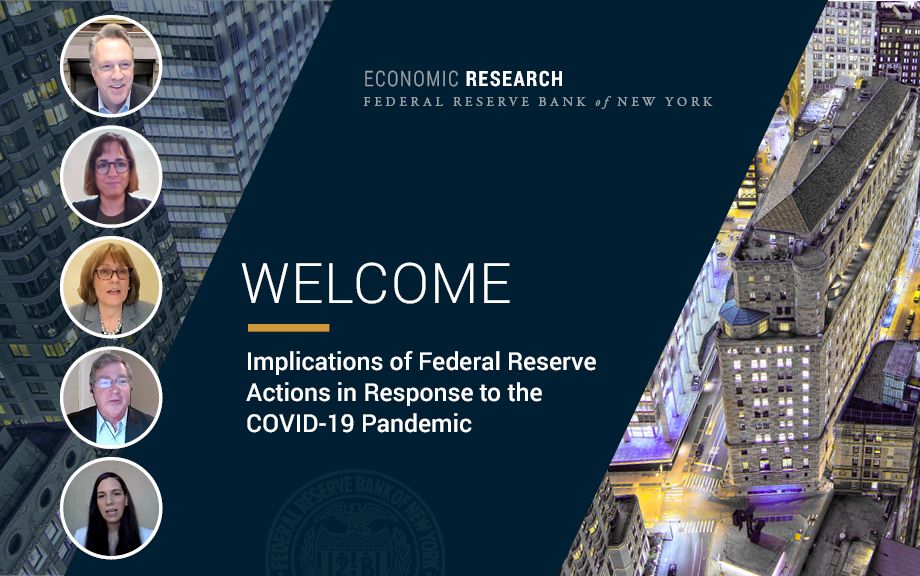
On September 30 and October 1, 2021, the New York Fed held a virtual conference on the implications of the Fed’s actions in response to the COVID-19 pandemic. New York Fed President John Williams gave the opening and concluding remarks.
Posted at 12:00 pm in COVID-19 Facilities, Crisis, Federal Reserve, Monetary Policy, Recession | Permalink
April 5, 2021
“Excess Savings” Are Not Excessive

How will the U.S. economy emerge from the ongoing COVID-19 pandemic? Will it struggle to return to prior levels of employment and activity, or will it come roaring back as soon as vaccinations are widespread and Americans feel comfortable travelling and eating out? Part of the answer to these questions hinges on what will happen to the large amount of “excess savings” that U.S. households have accumulated since last March. According to most estimates, these savings are around $1.6 trillion and counting. Some economists have expressed the concern that, if a considerable fraction of these accumulated funds is spent as soon as the economy re-opens, the ensuing rush of demand might be destabilizing. This post argues that these savings are not that excessive, when considered against the backdrop of the unprecedented government interventions adopted over the past year in support of households and that they are unlikely to generate a surge in demand post-pandemic.
Posted at 7:00 am in Banks, Crisis, Household Finance, Labor Market, Macroeconomics, Pandemic, Unemployment | Permalink | Comments (1)
January 12, 2021
Understanding the Racial and Income Gap in Covid‑19: Health Insurance, Comorbidities, and Medical Facilities

Our previous work documents that low-income and majority-minority areas were considerably more affected by COVID-19, as captured by markedly higher case and death rates. In a four-part series starting with this post, we seek to understand the reasons behind these income and racial disparities. Do disparities in health status translate into disparities in COVID-19 intensity? Does the health system play a role through health insurance and hospital capacity? Can disparities in COVID-19 intensity be explained by high-density, crowded environments? Does social distancing, pollution, or the age composition of the county matter? Does the prevalence of essential service jobs make a difference? This post will focus on the first two questions. The next three posts in this series will focus on the remaining questions. The posts will follow a similar structure. In each post, we will aim to understand whether the factors considered in that post affect overall COVID-19 intensity, whether the racial and income gaps can be further explained when we additionally include the factors in consideration in that post, and whether and to what extent the factors under consideration in that post independently affect racial and income gaps in COVID-19 intensity (without controlling for the factors considered in the other posts in this series).
December 2, 2020
The Regional Economy during the Pandemic

The New York-Northern New Jersey region experienced an unprecedented downturn earlier this year, one more severe than that of the nation, and the region is still struggling to make up the ground that was lost. That is the key takeaway at an economic press briefing held today by the New York Fed examining economic conditions during the pandemic in the Federal Reserve’s Second District. Despite the substantial recovery so far, business activity, consumer spending, and employment are all still well below pre-pandemic levels in much of the region, and fiscal pressures are mounting for state and local governments. Importantly, job losses among lower-income workers and people of color have been particularly consequential. The pace of recovery was already slowing in the region before the most recent surge in coronavirus cases, and we are now seeing signs of renewed weakening as we enter the winter.
Posted at 1:00 pm in Crisis, Employment, Household Finance, Inequality, Labor Market, New Jersey, New York, Pandemic, Regional Analysis, Unemployment | Permalink
 RSS Feed
 Follow Liberty Street Economics
