










231 posts on "Household Finance"
February 13, 2018
Just Released: Great Recession’s Impact Lingers in Hardest‑Hit Regions

The New York Fed’s Center for Microeconomic Data today released our Quarterly Report on Household Debt and Credit for the fourth quarter of 2017. Along with this report, we have posted an update of state-level data on balances and delinquencies for 2017. Overall aggregate debt balances increased again, with growth in all types of balances except for home equity lines of credit. In our post on the first quarter of 2017 we reported that overall balances had surpassed their peak set in the third quarter of 2008—the result of a slow but steady climb from several years of sharp deleveraging during the Great Recession.
Posted at 11:00 am in Credit, Household Finance, Housing, Recession, Regional Analysis | Permalink | Comments (2)
December 20, 2017
The Fed’s Balance Sheet, Night Lights, and the Other Top LSE Posts of 2017

In the spirit of this season of year-end lists of accomplishments, Liberty Street Economics offers a roundup of our most viewed posts. Our readers continued to gravitate toward timely, topical posts; our most popular explained how the Fed manages its enlarged balance sheet—a major focus of the FOMC, Congress, markets, and economists. Prompted by reader questions in response to their first post, the authors also penned a follow-up post. Another hit this year described an innovative indicator of economic growth—night light intensity measured via satellite—and used it to fact-check official Chinese growth estimates.
November 22, 2017
Are Student Loan Defaults Cyclical? It Depends

This post is the second in a two-part series on student loan default behavior. In the first post , we studied how educational characteristics (school type and selectivity, graduation, and major) and family background relate to the incidence of student loan default. In this post, we investigate whether default behavior has varied across cohorts of borrowers as the labor market evolved over time. Specifically, does the ability of student loan holders to repay their loans vary with the state of the labor market? Does the type of education these students received make any difference to this relationship?
November 20, 2017
Who Is More Likely to Default on Student Loans?

This post seeks to understand how educational characteristics (school type and selectivity, graduation status, major) and family background relate to the incidence of student loan default. Student indebtedness has grown substantially, increasing by 170 percent between 2006 and 2016. In addition, the fraction of students who default on those loans has grown considerably. Of students who left college in 2010 and 2011, 28 percent defaulted on their student loans within five years, compared with 19 percent of those who left school in 2005 and 2006. Since defaulting on student loans can have serious consequences for credit scores and, by extension, the ability to purchase a home and take out other loans, it’s critical to understand how college and family characteristics correspond to default rates.
November 14, 2017
Just Released: Auto Lending Keeps Pace as Delinquencies Mount in Auto Finance Sector

Total household debt increased by $116 billion to reach $12.96 trillion in the third quarter of 2017, according to the latest Quarterly Report on Household Debt and Credit released today by the New York Fed’s Center for Microeconomic Data. Household debt has been growing since mid-2013, boosted in part by steady growth in auto loan balances, which have grown for twenty-six consecutive quarters thanks to record-high levels of newly originated loans. Although new vehicle sales had begun to slump over the summer after several strong years of growth, September and October saw a rebound in sales, ending with over 18 million vehicles sold (seasonally adjusted at an annualized rate), and auto loan originations in the third quarter were commensurate with these numbers. In this post, we revisit the state of auto lending and auto loan performance, using the New York Fed Consumer Credit Panel which is based on Equifax credit data.
November 8, 2017
Understanding Permanent and Temporary Income Shocks

The earnings of 200 million U.S. workers change each year for various reasons. Some of these changes are anticipated while others are more unexpected. Although many of these changes may be due to pleasant surprises—such as receiving salary raises and promotions—others involve disappointments—such as falling into unemployment. Arguably, some of these factors have rather short-lived effects on an individual’s earnings, whereas others may have permanent effects. Many labor economists have been interested in these various shocks to earnings. How big are the more permanent shocks to earnings? How large are they relative to those that are temporary in nature? What are the sources of these shocks? In this blog post, we exploit a novel data set that enables us to explore the properties of earnings shocks: their magnitudes as well as their origins.
August 15, 2017
Just Released: More Credit Cards, Higher Limits, and . . . an Uptick in Delinquency

Today the New York Fed’s Center for Microeconomic Data released its Quarterly Report on Household Debt and Credit for the second quarter of 2017.
May 17, 2017
Household Borrowing in Historical Perspective

Today, the New York Fed’s Center for Microeconomic Data released its Quarterly Report on Household Debt and Credit for the first quarter of 2017.
May 15, 2017
Do Credit Markets Watch the Waving Flag of Bankruptcy?
Paul Goldsmith-Pinkham explores how the lifting of bankruptcy flags affects borrowers’ credit scores and credit outcomes.
May 11, 2017
Just Released: 2017 SCE Housing Survey Finds Increased Optimism about Home Price Growth
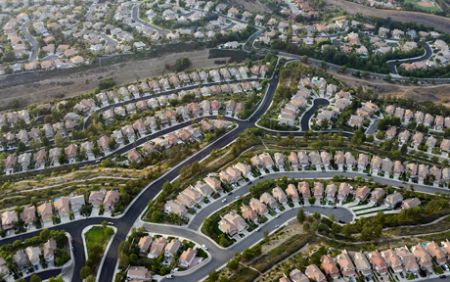
The Federal Reserve Bank of New York’s 2017 SCE Housing Survey indicates that expected home price growth over the next year has increased compared with twelve months earlier, and is at its highest level since the survey’s inception in 2014.
 RSS Feed
 Follow Liberty Street Economics
