










158 posts on "Labor Market"
September 21, 2020
How Did State Reopenings Affect Small Businesses?
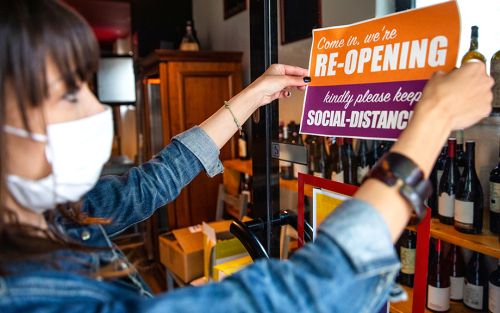
In our previous post, we looked at the effects that the reopening of state economies across the United States has had on consumer spending. We found a significant effect of reopening, especially regarding spending in restaurants and bars as well as in the healthcare sector. In this companion post, we focus specifically on small businesses, using two different sources of high-frequency data, and we employ a methodology similar to that of our previous post to study the effects of reopening on small business activity along various dimensions. Our results indicate that, much like for consumer spending, reopenings had positive and significant effects in the short term on small business revenues, the number of active merchants, and the number of employees working in small businesses. It is important to stress that we are not expressing any views in this post on the normative question of whether, when, or how states should loosen or tighten restrictions aimed at controlling the COVID-19 pandemic.
Posted at 7:00 am in Crisis, Employment, Household Finance, Labor Market, Macroeconomics, Pandemic, Unemployment | Permalink
July 13, 2020
Delaying College During the Pandemic Can Be Costly
Many students are reconsidering their decision to go to college in the fall due to the coronavirus pandemic. Indeed, college enrollment is expected to be down sharply as a growing number of would-be college students consider taking a gap year. In part, this pullback reflects concerns about health and safety if colleges resume in-person classes, or missing out on the “college experience” if classes are held online. In addition, poor labor market prospects due to staggeringly high unemployment may be leading some to conclude that college is no longer worth it in this economic environment. In this post, we provide an economic perspective on going to college during the pandemic. Perhaps surprisingly, we find that the return to college actually increases, largely because the opportunity cost of attending school has declined. Furthermore, we show there are sizeable hidden costs to delaying college that erode the value of a college degree, even in the current economic environment. In fact, we estimate that taking a gap year reduces the return to college by a quarter and can cost tens of thousands of dollars in lost lifetime earnings.
June 16, 2020
Finally, Some Signs of Improvement in the Regional Economy
The Federal Reserve Bank of New York’s June business surveys show some signs of improvement in the regional economy. Following two months of unprecedented decline due to the coronavirus pandemic, indicators of business activity point to a slower pace of contraction in the service sector and signs of a rebound in the manufacturing sector. Even more encouraging, as the regional economy has begun to reopen, many businesses have started to recall workers who were laid off or put on furlough since the start of the pandemic. Some have even hired new workers. Moreover, businesses expect to recall even more workers over the next month. Looking ahead, firms have become increasingly optimistic that conditions will improve in the coming months.
Posted at 8:30 am in Employment, Human Capital, Labor Market, New Jersey, New York, Pandemic, Regional Analysis, Unemployment | Permalink
May 29, 2020
Which Workers Bear the Burden of Social Distancing Policies?

This analysis identifies the types of workers bearing the highest cost from social distancing practices–an issue of great relevance for policymakers trying to address the fallout from the COVID-19 pandemic.
May 27, 2020
Job Training Mismatch and the COVID‑19 Recovery: A Cautionary Note from the Great Recession

Displaced workers have been shown to endure persistent losses years beyond their initial job separation events. These losses are especially amplified during recessions. (1) One explanation for greater persistence in downturns relative to booms, is that firms and industries on the margin of structural change permanently shift the types of tasks and occupations demanded after a large negative shock (Aghion et al. (2005)), but these new occupations do not match the stock of human capital held by those currently displaced. In response to COVID-19, firms with products and services that complement social-distancing (like Amazon distribution centers) may continue hiring during and beyond the recovery, while workers displaced from higher risk industries with more stagnant demand (for example, airport personnel, local retail clerks) are left to adjust to unfamiliar job opportunities. As some industries reopen gradually while others remain stunted, what role might workforce development programs have in bridging the skill gap such that displaced workers are best prepared for this new reality of work?
May 7, 2020
Translating Weekly Jobless Claims into Monthly Net Job Losses
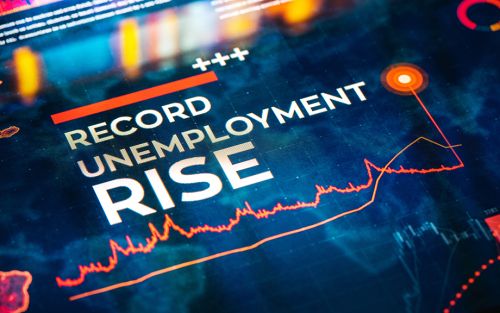
News headlines highlighting the loss of 26 million jobs (so far) underscore the massive shock that has hit the U.S. economy and the dislocation, hardship, and stress it has caused for so many American workers. But how accurately does this number actually capture the number of net job losses? In this post, we look at some of the statistical anomalies and quirks in the weekly claims series and offer a guide to interpreting these numbers. What we find is that the relationship between jobless claims and payroll employment for the month can vary substantially, depending on the nature, timing, and persistence of the disaster.
Posted at 7:00 am in Human Capital, Labor Market, Pandemic, Regional Analysis, Unemployment | Permalink | Comments (4)
April 16, 2020
How Widespread Is the Impact of the COVID‑19 Outbreak on Consumer Expectations?

In a recent blog post, we showed that consumer expectations worsened sharply through March, as the COVID-19 epidemic spread and affected a growing part of the U.S. population. In this post, we document how much of this deterioration can be directly attributed to the coronavirus outbreak. We then explore how the effect of the outbreak has varied over time and across demographic groups.
April 10, 2020
The Coronavirus Shock Looks More like a Natural Disaster than a Cyclical Downturn
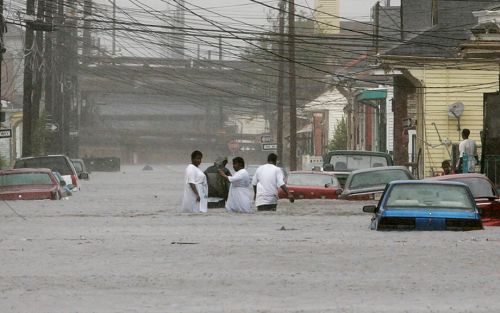
It’s tempting to compare the economic fallout from the coronavirus pandemic to prior business cycle downturns, particularly the Great Recession. However, such comparisons may not be particularly apt—as evidenced by the unprecedented surge in initial jobless claims over the past three weeks. Recessions typically develop gradually over time, reflecting underlying economic and financial conditions, whereas the current economic situation developed suddenly as a consequence of a fast-moving global pandemic. A more appropriate comparison would be to a regional economy suffering the effects of a severe natural disaster, like Louisiana after Hurricane Katrina or Puerto Rico after Hurricane Maria. To illustrate this point, we track the recent path of unemployment claims in the United States, finding a much closer match with Louisiana after Katrina than the U.S. economy following the Great Recession.
Posted at 7:00 am in Employment, Labor Market, Pandemic, Regional Analysis | Permalink | Comments (4)
March 4, 2020
How Does Credit Access Affect Job‑Search Outcomes and Sorting?
The analysis considers how access to consumer credit influences the job search behavior of displaced workers.
Searching for Higher Job Satisfaction
Using data from the New York Fed’s Survey of Consumer Expectations, these Liberty Street Economics authors document the heterogeneity in job satisfaction among U.S. workers and in their preferences for various nonwage benefits, and discuss the impact of these preferences on job search behavior.
 RSS Feed
 Follow Liberty Street Economics
