










62 posts on "New York"
December 4, 2018
Just Released: Labor Markets in the Region Are Exceptionally Tight

At today’s economic press briefing, we examined labor market conditions across our District, which includes New York State, Northern New Jersey, and Fairfield County, Connecticut, as well as Puerto Rico and the U.S. Virgin Islands. As the island economies continue to recover and rebuild from the destruction caused by last year’s hurricanes, employment has edged up in Puerto Rico and stabilized in the U.S. Virgin Islands. Meanwhile, as has been true throughout the expansion, New York City remains an engine of job growth, while employment gains have been more moderate in Northern New Jersey and fairly sluggish across most of upstate New York. Nonetheless, it has become more difficult for firms to find workers throughout the New York-Northern New Jersey region. It may not be terribly surprising that labor markets have tightened in and around New York City, where job growth has been strong, but labor markets have also tightened in parts of upstate New York, even in places where there has been little or no job growth. This is because labor markets are tightening as a result of changes in both labor demand and labor supply. In upstate New York, a decline in the labor force has reduced the pool of available workers.
November 19, 2018
“Skin in the Game,” Depositor Discipline, and Bank Risk Taking

In a previous post, we argued that double liability for bank owners might not limit their risk taking, despite the extra “skin in the game,” if it also weakens depositor discipline of banks. This post, drawing on our recent working paper, looks at the interplay of those opposing forces in the late 1920s when bank liability differed across states. We find that double liability may have reduced the outflow of deposits during the crisis, but wasn’t successful in mitigating bank risk during the boom.
Posted at 7:00 am in Banks, Economic History, Financial Intermediation, New Jersey, New York | Permalink | Comments (3)
November 14, 2018
Just Released: New York State’s Community Colleges are Successfully Partnering with Employers
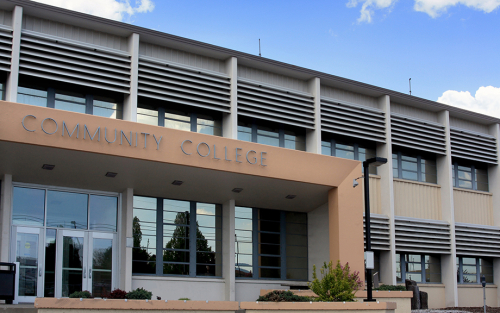
Community colleges frequently work with local employers to help shape the training of students and incumbent workers. This type of engagement has become an increasingly important strategy for community colleges to help students acquire the right skills for available jobs, and also helps local employers find and retain workers with the training they need. The Federal Reserve Bank of New York conducted a survey of community colleges in New York State with the goal of documenting the amount and types of these kinds of activities taking place. Our report, Employer Engagement by Community Colleges in New York State, summarizes the findings of our survey.
Posted at 12:00 pm in Education, Human Capital, Labor Market, New York, Regional Analysis | Permalink
June 27, 2018
Why New York City Subway Delays Don’t Affect All Riders Equally
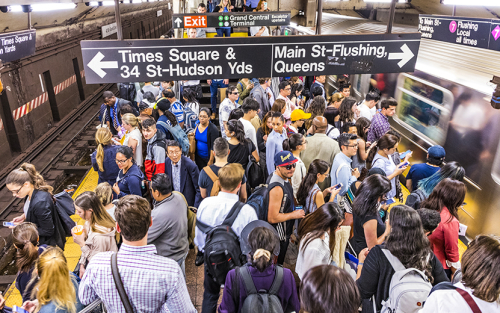
The state of the New York City subway system has worsened considerably over the past few years. As a consequence of rising ridership and decaying infrastructure, the network is plagued by delays and frequently fails to deliver New Yorkers to their destinations on time. While these delays are a headache for anyone who depends on the subway to get around, they do not affect all riders in the same way. In this post, we explain why subway delays disproportionately affect low-income New Yorkers. We show that wealthier commuters who rely on the subway are less likely to experience extensive issues on their commutes.
October 13, 2017
Upstate New York’s Expansion Is Losing Steam

All in all, the upstate New York economy fared pretty well during the last business cycle.
June 16, 2017
Just Released: June Regional Business Surveys Paint a Mixed Picture

Yesterday’s June Empire State Manufacturing Survey pointed to a significant increase in regional manufacturing activity. However, our parallel survey for the region’s service sector, the June Business Leaders Survey, released today, paints a somewhat dreary picture of regional service-sector activity. These two surveys, taken together, suggest that economic conditions in the New York-Northern New Jersey region are mixed.
October 19, 2016
Lower Manhattan since 9/11: A Study in Resilience
The 9/11 terrorist attack on the World Trade Center left a deep scar on New York City and the nation, most particularly in terms of the human toll.
June 6, 2016
Just Released: Mapping the Differences in School Spending in New York City

Rajashri Chakrabarti and Michael Stewart This morning, the Federal Reserve Bank of New York released a set of interactive visuals that present data on school spending and its various components—such as instructional spending, instructional support, leadership support, and building services spending—across all thirty-two community school districts (CSD) in New York City and map their progression […]
March 25, 2016
Upstate New York Job Growth: The Bad News Is that the Good News Was Wrong

In 2015, upstate New York looked to be having its strongest job growth in years. Employment was estimated to be growing at around one percent—below the national pace, but twice the region’s trend growth rate since the end of the Great Recession.
August 26, 2015
Just Released: An Update on Regional Economic Conditions Provided at Our Economic Press Briefing
Jaison R. Abel, Jason Bram, Richard Deitz, and James Orr Today’s Economic Press Briefing at the New York Fed presented our economic outlook for New York, Northern New Jersey, and Puerto Rico. We showed that many parts of the region have bounced back quite well from the Great Recession and are growing at a solid […]
 RSS Feed
 Follow Liberty Street Economics
