










The past year brought dramatic changes to U.S. trade policy, including sweeping new tariffs, as well as a Supreme Court decision that further reshaped the tariff landscape. Many businesses saw their costs increase significantly and faced complex decisions about whether to absorb the tariffs through lower profit margins, raise their prices to recover the higher costs, or some combination of the two. Last year, we found that most businesses had passed on at least some of these higher costs to their customers through higher prices. Now, over a year later, have businesses finished adjusting prices, or do further tariff-induced price increases lie ahead? Our latest regional business surveys reveal that nearly half of firms that have paid tariffs still plan additional price increases to offset these costs, with some expecting to raise prices six months or more in the future.
Many Businesses Are Not Finished Raising Prices to Offset Tariffs
Tariffs are taxes on imports that can raise the cost of inputs used to produce domestic goods and services. Indeed, recent research has shown that nearly 90 percent of the economic burden of tariffs has fallen on U.S. firms and consumers. Two-thirds of service firms and almost all manufacturers responding to our surveys import at least some of their inputs. Among these importing firms, 40 percent of service firms and 70 percent of manufacturers said they directly paid tariffs over the past twelve months, though many others faced higher costs on imported inputs from their suppliers who paid the tariffs and charged higher prices to their customers.
The chart below tracks tariff pass-through behavior by those businesses that paid tariffs directly. A small share of these businesses reported that tariffs had an insignificant impact on their costs—3 percent of service firms and 8 percent of manufacturers—shown by the bottom dark blue bars. Roughly 30 percent of service providers and 20 percent of manufacturers reported that they had fully passed through tariffs to customers by raising prices, meaning they have no need for further adjustments to cover tariffs. Another 20 percent of service firms and 30 percent of manufacturers do not plan additional price hikes in the future, regardless of tariffs they have already paid. Collectively, businesses in these three categories—shown in shades of blue in the chart and representing just over half of tariff-paying firms—indicated they have no plans for further price increases to recoup tariff expenses.
More Price Increases Are Coming from Businesses That Paid Tariffs
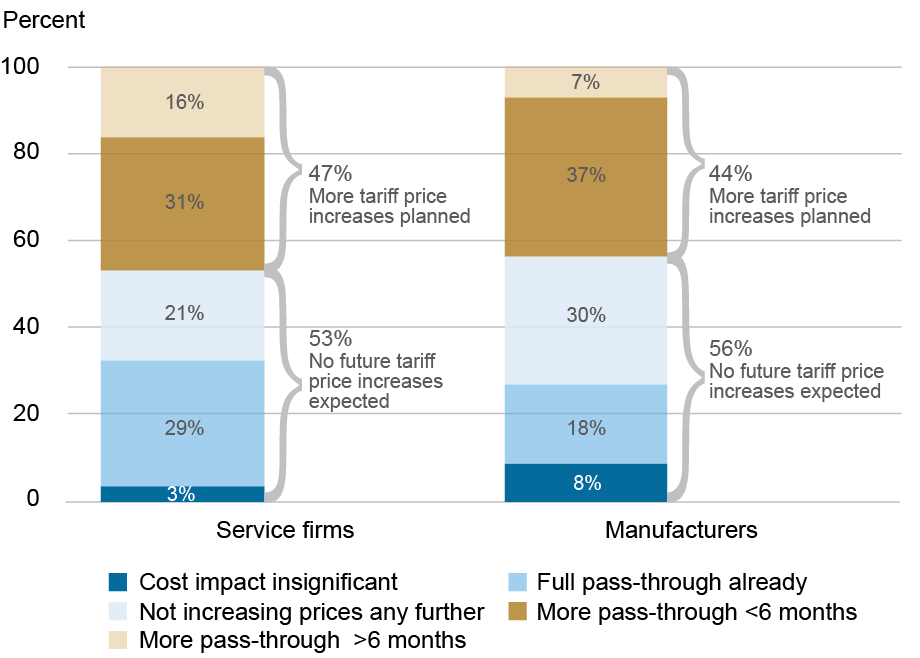
Note: Figures represent the shares of businesses that directly paid tariffs over the last twelve months.
That leaves 47 percent of service firms and 44 percent of manufacturers that paid tariffs directly saying they have more tariff-induced price increases to come—shown by the two shades of gold bars in the chart. Among tariff-paying service firms, roughly 30 percent plan additional cost increases within the next six months, as do nearly 40 percent of tariff-paying manufacturers. Notably, 16 percent of service firms and 7 percent of manufacturers plan tariff-induced price increases more than six months from now.
These results suggest that many businesses are still adjusting their prices, more than a year after tariffs were first introduced. It is not clear whether firms are responding to a single round of tariffs or to the sequence of increases that has unfolded over the past year or more. What is clear is that the adjustment has been gradual, in line with a growing body of research showing that tariffs pass through to consumer prices incrementally, building over the better part of a year rather than all at once.
Why Businesses Are Planning Future Price Increases
In our surveys, businesses cited two main reasons for planning price increases so far into the future.
First, some businesses operate under contracts with fixed selling prices and are unable to raise prices until such contracts expire, forcing them to absorb cost increases in the meantime. Indeed, research has found that long-term contracts can impede businesses from passing through cost increases.
Second, some businesses reported taking a “trickle up” approach to price increases, where they gradually raise prices over time rather than immediately raising prices to fully cover tariffs. This pricing strategy allows firms to avoid shocking their customers with sharp price increases while retaining the ability to accelerate price increases if input costs continue to rise. Moreover, uncertainty surrounding future tariff policies—including potential rate changes, exemptions, or tariff responses from other countries—may be causing some firms to adopt cautious, incremental pricing strategies rather than making large, discrete adjustments. This behavior extends the period over which tariff-related price pressures work their way through the economy.
Pricing Pressures May Be Persistent
While economists and policymakers often expect that price increases due to tariffs will constitute a one-time price-level adjustment, what “one-time” means in practice may be a drawn-out affair, especially when the tariffs change frequently. Our business surveys suggest that, in an ever-changing tariff environment, many firms are spreading price increases across extended periods—meaning that inflationary pressures due to tariffs may well last for some time to come.

Jaison R. Abel is head of Microeconomics in the Federal Reserve Bank of New York’s Research and Statistics Group.

Mary Amiti is head of Labor and Product Markets in the Federal Reserve Bank of New York’s Research and Statistics Group.

Richard Deitz is an economic policy advisor in the Federal Reserve Bank of New York’s Research and Statistics Group.

Sebastian Heise is a research economist in the Federal Reserve Bank of New York’s Research and Statistics Group.

Nick Montalbano is a data analytics specialist in the Federal Reserve Bank of New York’s Research and Statistics Group.
How to cite this post:
Jaison R. Abel, Mary Amiti, Richard Deitz, Sebastian Heise, and Nick Montalbano, “More Tariff Pass‑Through Is in the Pipeline,” Federal Reserve Bank of New York Liberty Street Economics, July 8, 2026, https://doi.org/10.59576/lse.20260708
BibTeX: View |

Disclaimer
The views expressed in this post are those of the author(s) and do not necessarily reflect the position of the Federal Reserve Bank of New York or the Federal Reserve System. Any errors or omissions are the responsibility of the author(s).
 RSS Feed
 Follow Liberty Street Economics
