











Geoeconomic risk—the risk that firms incur valuation losses when countries deploy economic, trade, or financial leverage for geopolitical aims—has become a first-order concern for investors. In this post, based on our recent Staff Report, we document that domestic U.S. stocks expose investors to substantial geoeconomic risk through firms’ global supply-chain relationships, affecting investors’ returns and portfolio allocation. We also find that investors are compensated for bearing geoeconomic risk through higher risk premia.
Export Controls as Geoeconomic Shocks
Investors do not need to own foreign stocks to be exposed to geoeconomic risk. Domestic stocks can embed foreign exposures when U.S. firms sell to overseas customers or rely on global supply chains. These links mean that a foreign policy shock can reduce the value of U.S.-listed firms and transmit geoeconomic risk to domestic portfolios. These global links can help investors diversify their portfolios when shocks are country- or –market-specific, but they offer less protection when policy shocks affect the same international relationships across many U.S. firms. Geoeconomic shocks are therefore difficult to diversify away because they can affect multiple domestic stocks through a common foreign exposure.
We study this risk through the imposition of U.S. export controls by the Bureau of Industry and Security. This agency of the Department of Commerce can restrict U.S. firms from selling certain technologies to specific foreign entities deemed to be a risk to U.S. national security. Since 2014, these restrictions have been leveraged frequently in the U.S.-China technological rivalry, especially in industries such as semiconductors, telecommunications, artificial intelligence, and advanced computing. We interpret the addition of a foreign firm to the export control list as a manifestation of geoeconomic risk for its U.S. suppliers.
This setting lets us trace geoeconomic risk from targeted Chinese firms to U.S. investors. We hand-collect Chinese entities added to U.S. export-control lists and use FactSet Revere supply-chain data to identify the U.S. suppliers connected to these directly targeted Chinese customers. We then match those affected U.S. suppliers to the holdings of U.S. domestic equity mutual funds from the CRSP Mutual Fund Database, covering more than 5,000 funds from 2010 to 2023. We focus on mutual funds because they are major investors in U.S. equity markets: long-term mutual funds held around a fifth of U.S. corporate equity in 2025. In addition, thanks to their monthly portfolio holdings, we observe which funds owned U.S. suppliers to newly targeted Chinese firms when export controls are announced, and to track how managers rebalance their portfolios afterward.
Geoeconomic Risk in Domestic Portfolios
Despite their ostensible focus, domestic equity funds have significant exposure to the U.S.-China geoeconomic competition. On average, 20.3 percent of fund assets are invested in U.S. firms with at least one Chinese customer. The chart below shows that this exposure is especially high for investment styles tied to growth and technology. For example, science and technology funds invest 43.3 percent of their portfolios in domestic firms that are connected to Chinese customers. Within these China-connected portfolios, U.S. suppliers to Chinese customers newly targeted by export controls account for 8.4 percent of assets.
Domestic Funds Differ Widely in Their Exposure to the U.S.-China Competition
Growth Funds
China exposure (percentage of fund assets)
Science & Technology Funds
China exposure (percentage of fund assets)
Industrial Funds
China exposure (percentage of fund assets)
Mid/Small – Cap Funds
China exposure (percentage of fund assets)
Sources: CRSP Mutual Fund Database; FactSet Revere.
Note: This chart shows the share of U.S. domestic equity mutual fund portfolios that are invested in U.S. firms with Chinese customers, by investment style.
Although export controls directly target Chinese firms, they also reduce the value of those firms’ U.S. suppliers. The chart below shows that, in our data, U.S. suppliers experience a cumulative abnormal stock return of −3.6 percent right after the announcement that export controls target one or more of their Chinese customers, with most of the decline occurring during the first five trading days.
Stocks of U.S. Suppliers Fall when Their Chinese Customers Are Added to the Export Control List
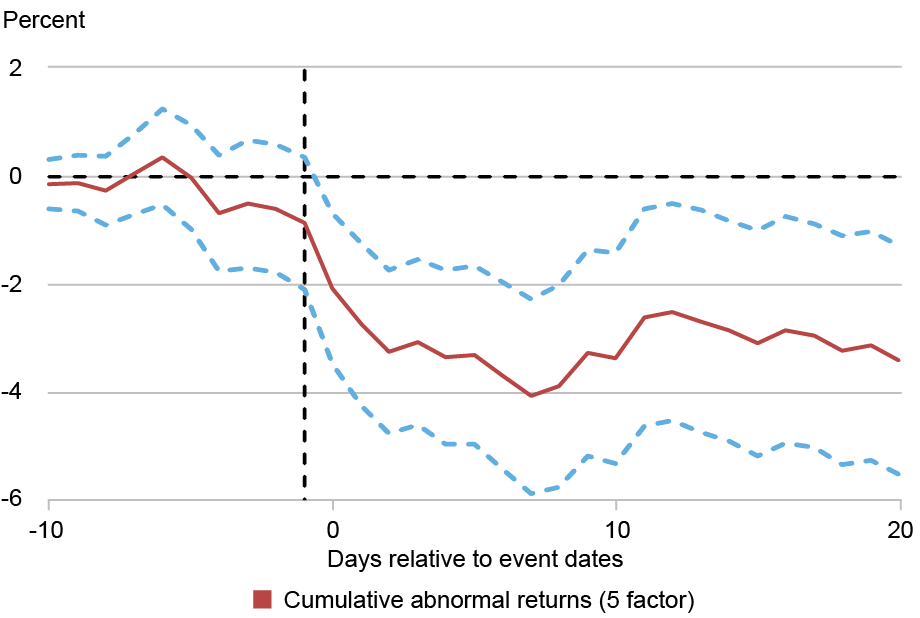
Notes: The chart shows cumulative abnormal returns for stocks issued by U.S. firms that supply directly targeted Chinese customers around the announcement that those customers are added to a U.S. export-control list. The chart is based on the Fama-French five-factor model.
These price movements extend to the mutual funds holding these stocks. We measure a fund’s exposure to new export controls as the share of its portfolio invested in affected U.S. suppliers in that month. We then compare funds with higher and lower exposure to export controls within the same investment style and month, while controlling for fund characteristics. Funds holding stocks of affected U.S. suppliers experience higher volatility and lower (raw and factor-adjusted) returns following the imposition of export controls. Conditional on an export control event, a one standard deviation increase in exposure (2.5 percent) is associated with a 22-basis-point decline in monthly returns.
Mutual Funds Respond by Rebalancing Away from Geoeconomic Risk
Active managers reduce holdings of affected U.S. suppliers and also sell other China-linked U.S. firms not affected by the current announcement. The selling of affected U.S. suppliers, still visible three months after the export controls, suggests that managers do not generally treat the price decline as a purely temporary idiosyncratic shock. This broader selling suggests that investors learn that geoeconomic risk may be embedded in complex supply-chain links that were not fully priced or understood before the shock. In sum, export controls might serve as a wake-up call, prompting investors to learn more about a portfolio’s indirect exposure to China and to the possibility of future restrictions.
This portfolio rebalancing is driven entirely by active funds, consistent with passive funds simply tracking benchmark indices. For a one standard deviation increase in exposure, passive funds experience a 31-basis-point decline in monthly returns, compared with 22 basis points for active funds. In the following month, passive funds also experience outflows equivalent to about 0.35 percent of assets, while the outflows from active funds are statistically insignificant.
Active managers therefore appear to partially insulate fund performance from geoeconomic shocks, but this insulation comes with higher risk-taking. Specifically, exposed active funds subsequently hold more concentrated portfolios and tilt toward “lottery-like” stocks, suggesting that some managers respond to performance shortfalls by taking on additional risk to limit future outflows.
Specialist managers and higher-fee funds experience smaller performance declines after export control shocks, while traditional market-timing and stock-picking skills do not predict better outcomes. In sum, the management of geoeconomic risk might require the ability to map potential policy shocks onto firms’ positions in global value chains.
Is Geoeconomic Risk Priced In?
Consistent with the portfolio evidence, investors seem to require compensation for bearing geoeconomic risk. We sort stocks based on prior exposure to export controls and compare future returns of high-exposure and low-exposure firms. A long-short portfolio that buys firms previously exposed to export controls and shorts unexposed firms earns about 1 percent per month in abnormal returns after adjusting for standard risk factors. In other words, the market appears to treat geoeconomic exposure not as a one-time news event, but as a priced risk for which investors demand compensation.
Summing Up
As economic policy becomes more closely tied to national security, firms’ supply-chain links can become a channel through which geoeconomic shocks affect investors’ portfolios. For investors, the relevant question is therefore not only where a stock is listed, but where the firm earns revenues and how exposed those relationships are to geopolitical policy shocks. Diversification across domestic stocks may not fully mitigate this risk when many firms share similar global exposures. In this environment, understanding the global linkages of portfolio firms becomes increasingly important for understanding portfolio risk.

Matteo Crosignani is a financial research advisor in the Federal Reserve Bank of New York’s Research and Statistics Group.
Lina Han is an assistant professor of finance at the University of Massachusetts Amherst.
Marco Macchiavelli is an assistant professor of finance at the University of Massachusetts Amherst.
This post has been published simultaneously, with minor changes, on VoxEU.org.
How to cite this post:
Matteo Crosignani, Lina Han, and Marco Macchiavelli, “Navigating Geoeconomic Risk in the U.S. Stock Market,” Federal Reserve Bank of New York Liberty Street Economics, October 1, 2026, https://doi.org/10.59576/lse.20261001
BibTeX: View |


Disclaimer
The views expressed in this post are those of the author(s) and do not necessarily reflect the position of the Federal Reserve Bank of New York or the Federal Reserve System. Any errors or omissions are the responsibility of the author(s).
 You can follow this conversation by subscribing to the comment feed for this post.
 RSS Feed
 Follow Liberty Street Economics
