










260 posts on "Financial Institutions"
February 19, 2016
Quantifying Potential Spillovers from Runs on High‑Yield Funds

On December 9, 2015, Third Avenue Focused Credit Fund (FCF) announced a “Plan of Liquidation,” effectively halting investor redemptions.
Posted at 7:00 am in Corporate Finance, Financial Institutions, Financial Markets, Liquidity | Permalink | Comments (1)
February 18, 2016
Are Asset Managers Vulnerable to Fire Sales?

According to conventional wisdom, an open-ended investment fund that has a floating net asset value (NAV) and no leverage will never experience a run and hence never have to fire-sell assets.
February 10, 2016
Further Analysis of Corporate Bond Market Liquidity

Tobias Adrian, Michael Fleming, Erik Vogt, and Zachary Wojtowicz Our earlier analyses from last October and earlier in this series looked at market liquidity measures averaged across all corporate bonds or broad sub-groups of corporate bonds. Commentators have pointed out that such broad averages might mask important differences among narrower sub-groups of bonds and that […]
February 8, 2016
Continuing the Conversation on Liquidity

Tobias Adrian, Michael J. Fleming, and Ernst Schaumburg Market participants and policymakers have raised concerns about market liquidity—the ability to buy and sell securities quickly, at any time, at minimal cost. Market liquidity supports the efficient allocation of financial capital, which is a catalyst for sustainable economic growth. Any possible decline in market liquidity, whether […]
February 5, 2016
Crisis Chronicles: The Long Depression and the Panic of 1873
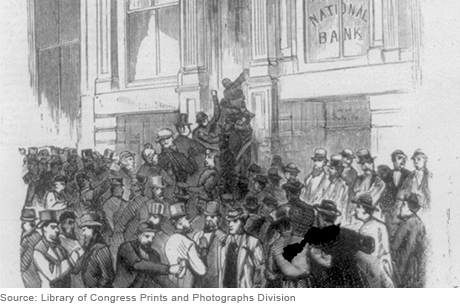
It always seemed to come down to railroads in the 1800s. Railroads fueled much of the economic growth in the United States at that time, but they required that a great deal of upfront capital be devoted to risky projects. The panics of 1837 and 1857 can both be pinned on railroad investments that went awry, creating enough doubt about the banking system to cause pervasive bank runs. The fatal spark for the Panic of 1873 was also tied to railroad investments—a major bank financing a railroad venture announced that it would suspend withdrawals. As other banks started failing, consumers and businesses pulled back and America entered what is recorded as the country’s longest depression.
Posted at 7:00 am in Crisis, Economic History, Financial Institutions, Inflation, Panic, Unemployment | Permalink | Comments (1)
December 7, 2015
Dealer Positioning and Expected Returns
Tobias Adrian, Michael Fleming, and Erik Vogt Securities broker-dealers (dealers) trade securities on behalf of their customers and themselves. Recently, analysts have pointed to the decline in U.S. dealers’ corporate bond inventories as evidence that dealers’ market making capacity is impaired. However, historically such inventories also reflect dealers’ risk management and proprietary trading activities. In […]
Posted at 7:00 am in Financial Institutions, Financial Markets, Liquidity, Treasury | Permalink | Comments (2)
November 30, 2015
U.S. Banks’ Changing Footprint at Home and Abroad

Linda Goldberg and Rose Wang investigate changes in bank holding company (BHC) geography, especially the rising share of BHC affiliates in tax havens and financial secrecy jurisdictions.
October 15, 2015
Evaluating the Rescue of Fannie Mae and Freddie Mac
In September 2008, the U.S. government engineered a dramatic rescue of Fannie Mae and Freddie Mac, placing the two firms into conservatorship and committing billions of taxpayer dollars to stabilize their financial position.
October 14, 2015
Dealers’ Positions and the Auction Cycle
Michael J. Fleming and Collin Jones The aftermath of the financial crisis and changes in technology and regulation have spurred a spirited discussion of dealers’ evolving role in financial markets. One such role is to buy securities at auction and sell them off to investors over time. We assess this function using data on primary […]
October 8, 2015
Redemption Risk of Bond Mutual Funds and Dealer Positioning
Market participants have recently voiced concerns that bond markets seem to become illiquid precisely when they want to sell bonds.
 RSS Feed
 Follow Liberty Street Economics
