










This post presents the latest update of the economic forecasts generated by the Federal Reserve Bank of New York’s (FRBNY) dynamic stochastic general equilibrium (DSGE) model.
Look for our next post on September 18.
November 21, 2016
The FRBNY DSGE Model Forecast—November 2016
Posted at 7:00 am in DSGE, Expectations, Forecasting, Macroeconomics, Monetary Policy | Permalink | Comments (2)
November 18, 2016
Just Released: Press Briefing on the Survey of Consumer Expectations

The New York Fed’s Survey of Consumer Expectations (SCE) collects information on household heads’ economic expectations and behavior. In particular, the survey covers respondents’ views on how inflation, spending, credit access, and the housing and labor markets will evolve over time. The SCE yields important insights that inform our monetary policy decisions. This morning, President Dudley joined Bank economists to brief the press on the design of the SCE and the latest releases of survey results. President Dudley introduced the briefing by speaking about the benefits of measuring consumers’ expectations.
The Final Crisis Chronicle: The Panic of 1907 and the Birth of the Fed
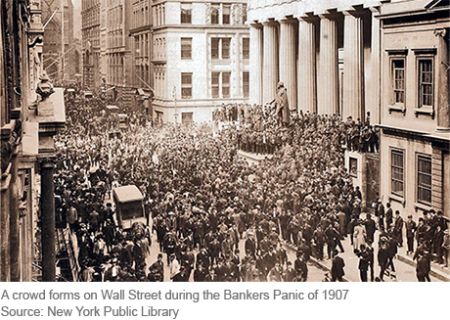
The panic of 1907 was among the most severe we’ve covered in our series and also the most transformative, as it led to the creation of the Federal Reserve System. Also known as the “Knickerbocker Crisis,” the panic of 1907 shares features with the 2007-08 crisis, including “shadow banks” in the form high-flying, less-regulated trusts operating beyond the safety net of the time, and a pivotal “Lehman moment” when Knickerbocker Trust, the second-largest trust in the country, was allowed to fail after J.P. Morgan refused to save it.
Posted at 7:00 am in Crisis, Economic History, Financial Institutions, Financial Markets, Regulation, Treasury | Permalink
November 16, 2016
Escaping Unemployment Traps

Economic activity has remained subdued following the Great Recession. One interpretation of the listless recovery is that recessions inflict permanent damage on an economy’s productive capacity. For example, extended periods of high unemployment can lead to skill losses among workers, reducing human capital and lowering future output. This notion that temporary recessions have long-lasting consequences is often termed hysteresis. Another explanation for sluggish growth is the influential secular stagnation hypothesis, which attributes slow growth to long-term changes in the economy’s underlying structure. While these explanations are observationally similar, they have very different policy implications. In particular, if structural factors are responsible for slow growth, then there might be little monetary policy can do to reverse this trend. If instead hysteresis is to blame, then monetary policy may be able to reverse slowdowns in potential output, or even prevent them from occurring in the first place.
November 14, 2016
Inflation and Japan’s Ever‑Tightening Labor Market

Japan offers a preview of future U.S. demographic trends, having already seen a large increase in the population over 65.
Posted at 7:00 am in International Economics, Labor Market, Macroeconomics, Unemployment | Permalink | Comments (2)
November 9, 2016
Performance Bonds for Bankers: Taking Aim at Misconduct

Given the long list of problems that have emerged in banks over the past several years, it is time to consider performance bonds for bankers. Performance bonds are used to ensure that appropriate actions are taken by a party when monitoring or enforcement is expensive. A simple example is a security deposit on an apartment rental. The risk of losing the deposit motivates renters to take care of the apartment, relieving the landlord of the need to monitor the premises. Although not quite as simple as a security deposit, performance bonds for bankers could provide more incentive for bankers to take better care of our financial system.
Posted at 7:00 am in Corporate Finance, Expectations, Financial Markets, Regulation | Permalink | Comments (2)
November 7, 2016
What’s Driving the Recent Slump in U.S. Imports?

The growth in U.S. imports of goods has been stubbornly low since the second quarter of 2015, with an average annual growth rate of 0.7 percent.
October 24, 2016
Are Banks Being Roiled by Oil?
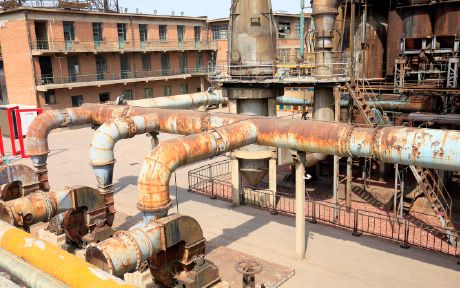
Profits and employment in the oil and natural gas extraction industry have fallen significantly since 2014, reflecting a sustained decline in energy prices. In this post, we look at how these tremors are affecting banks that operate in energy industry–intensive regions of the United States. We find that banks in the “oil patch” have experienced a significant rise in delinquencies on commercial and industrial loans. So far though, there appears to be limited evidence of spillovers to other types of loans and no evidence of widespread bank losses or failures in these regions.
October 21, 2016
From the Vault: Funds, Flight, and Financial Stability
The money market industry is in the midst of significant change. With the implementation this month of new Securities and Exchange Commission rules designed to make money market funds (MMFs) more resilient to stress, institutional prime and tax-exempt funds must report more accurate prices reflecting the net asset value (NAV) of shares based on market prices for the funds’ asset holdings, rather than promising a fixed NAV of $1 per share. The rules also permit prime funds, which invest in a mixture of corporate debt, certificates of deposit, and repurchase agreements, to impose fees or set limits on investors who redeem shares when market conditions sharply deteriorate. (Funds investing in government securities, which are more stable, are not subject to the new rules.) These changes, driven by a run on MMFs at the height of the financial crisis, add to earlier risk-limiting rules on portfolio holdings.
Posted at 7:00 am in Financial Institutions, Financial Markets, Regulation | Permalink | Comments (1)
October 19, 2016
Lower Manhattan since 9/11: A Study in Resilience
The 9/11 terrorist attack on the World Trade Center left a deep scar on New York City and the nation, most particularly in terms of the human toll.
 RSS Feed
 Follow Liberty Street Economics
