









In a recent post, we presented some preliminary evidence suggesting that corporate bond market liquidity is ample. That evidence relied on bid-ask spread and price impact measures.

At the New York Fed, our mission is to make the U.S. economy stronger and the financial system more stable for all segments of society. We do this by executing monetary policy, providing financial services, supervising banks and conducting research and providing expertise on issues that impact the nation and communities we serve.


In a recent post, we presented some preliminary evidence suggesting that corporate bond market liquidity is ample. That evidence relied on bid-ask spread and price impact measures.

Rich Podjasek, Linsey Molloy, Michael J. Fleming, and Andreas Fuster Mortgage-backed securities guaranteed by the government-backed entities Fannie Mae, Freddie Mac, and Ginnie Mae, or so-called “agency MBS,” are the primary funding source for U.S. residential housing. A significant deterioration in the liquidity of the MBS market could lead investors to demand a premium for […]

Tobias Adrian, Michael J. Fleming, and Ernst Schaumburg Market participants and policymakers have raised concerns about market liquidity—the ability to buy and sell securities quickly, at any time, at minimal cost. Market liquidity supports the efficient allocation of financial capital, which is a catalyst for sustainable economic growth. Any possible decline in market liquidity, whether […]
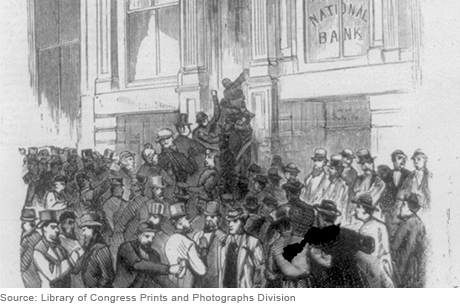
It always seemed to come down to railroads in the 1800s. Railroads fueled much of the economic growth in the United States at that time, but they required that a great deal of upfront capital be devoted to risky projects. The panics of 1837 and 1857 can both be pinned on railroad investments that went awry, creating enough doubt about the banking system to cause pervasive bank runs. The fatal spark for the Panic of 1873 was also tied to railroad investments—a major bank financing a railroad venture announced that it would suspend withdrawals. As other banks started failing, consumers and businesses pulled back and America entered what is recorded as the country’s longest depression.

The 2007-09 financial crisis, and the monetary policy response to it, have greatly increased the size of central bank balance sheets around the world.
There has been unusually high activity on central banks’ balance sheets in recent years.
What types of counterparties can borrow from or lend to a central bank, and what kind of collateral must they possess in order to receive a loan? These are two key aspects of a central bank’s monetary policy implementation framework. Since at least the nineteenth century, it has been understood that an important role of central banks is to lend to solvent but illiquid institutions, particularly during a crisis, as this provides liquidity insurance to the financial system. They also provide liquidity to markets during normal times as a means to implement monetary policy. Central banks that rely on scarcity of reserves need to adjust the supply of liquidity in the market, as described in our previous post[add link]. In this post, we focus on liquidity provision related to the conduct of monetary policy .
Emily Eisner, Antoine Martin, and Ylva Søvik In the minutes of the July 2015 Federal Open Market Committee (FOMC) meeting, the chair indicated that Federal Reserve staff would undertake an extended effort to evaluate potential long-run monetary policy implementation frameworks. But what is a central bank’s monetary policy implementation framework? In a series of four […]
Jaison R. Abel and Richard Deitz Many newly minted college graduates entering the labor market in the wake of the Great Recession have had a tough time finding good jobs. But just how difficult has it been, and are things getting better? And for which graduates? These questions can be difficult to answer because timely […]
 Liberty Street Economics is available on the iPhone® and iPad® and can be customized by economic research topic or economist.
 RSS Feed
 Follow Liberty Street Economics