










27 posts on "inequality"
October 7, 2019
Introduction to Heterogeneity Series: Understanding Causes and Implications of Various Inequalities
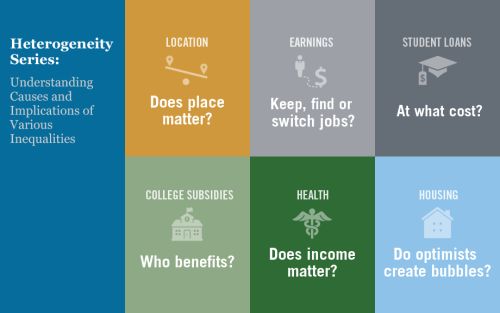
Economic analysis is often geared toward understanding the average effects of a given policy or program. Likewise, economic policies frequently target the average person or firm. While averages are undoubtedly useful reference points for researchers and policymakers, they don’t tell the whole story: it is vital to understand how the effects of economic trends and government policies vary across geographic, demographic, and socioeconomic boundaries. It is also important to assess the underlying causes of the various inequalities we observe around us, be they related to income, health, or any other set of indicators. Starting today, we are running a series of six blog posts (apart from this introductory post), each of which focuses on an interesting case of heterogeneity in the United States today.
Posted at 7:00 am in Education, Equitable Growth, Household Finance, Inequality, Labor Market, Regional Analysis | Permalink
July 10, 2019
Did the Value of a College Degree Decline during the Great Recession?

In an earlier post, we studied how educational attainment affects labor market outcomes and earnings inequality. In this post, we investigate whether these labor market effects were preserved across the last business cycle: Did students with certain types of educational attainment weather the recession better?
Posted at 7:00 am in Education, Human Capital, Inequality, Labor Market, Recession | Permalink | Comments (5)
September 5, 2018
Education’s Role in Earnings, Employment, and Economic Mobility

Amid dialogue about the soaring student loan burden, questions arise about how educational characteristics (school type, selectivity, and major) affect disparities in post-college labor market outcomes. In this post, we specifically explore the impact of such school and major choices on employment, earnings, and upward economic mobility. Insight into determinants of economic disparity is key for understanding long-term consumption and inequality patterns. In addition, this gives us a window into factors that could be used to ameliorate income inequality and promote economic mobility.
Posted at 7:00 am in Education, Equitable Growth, Human Capital, Inequality, Labor Market | Permalink
May 11, 2016
Household Consumption Mobility over the Life‑Cycle
Commonly used metrics of inequality and mobility attempt to capture how household (or individual) income compares to the rest of the population and how persistent that income is over the life cycle.
November 6, 2015
Health Inequality
However important income inequality is, it is only a partial representation of the inequality in well-being among individuals, households, counties, and other communities.
July 13, 2015
A Discussion of Thomas Piketty’s Capital in the Twenty‑First Century: By How Much Is r Greater than g?
Maxim Pinkovskiy describes the arguments that Thomas Piketty makes to conclude that wealth inequality will rise and that global capital taxation is needed to stop it, and offers a critical discussion of the arguments.
June 23, 2014
The Capitol Since the Nineteenth Century: Political Polarization and Income Inequality in the United States
Even the most casual observer of American politics knows that today’s Republican and Democratic parties seem to disagree with one another on just about every issue under the sun
 RSS Feed
 Follow Liberty Street Economics
