










393 posts on "Liberty Street Economics"
May 7, 2020
Translating Weekly Jobless Claims into Monthly Net Job Losses
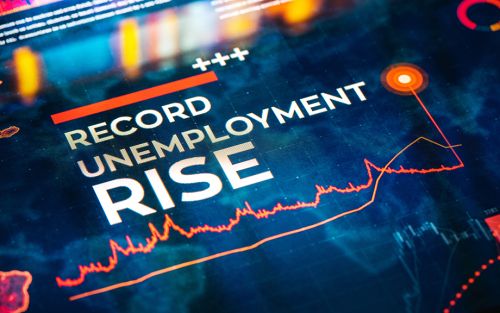
News headlines highlighting the loss of 26 million jobs (so far) underscore the massive shock that has hit the U.S. economy and the dislocation, hardship, and stress it has caused for so many American workers. But how accurately does this number actually capture the number of net job losses? In this post, we look at some of the statistical anomalies and quirks in the weekly claims series and offer a guide to interpreting these numbers. What we find is that the relationship between jobless claims and payroll employment for the month can vary substantially, depending on the nature, timing, and persistence of the disaster.
Posted at 7:00 am in Human Capital, Labor Market, Pandemic, Regional Analysis, Unemployment | Permalink | Comments (4)
May 6, 2020
Where Have the Paycheck Protection Loans Gone So Far?

The Paycheck Protection Program (PPP) is a central piece of the CARES Act. In the program’s first round, $349 billion in forgivable government-guaranteed loans were extended to small businesses to cover costs related to payroll and utilities, as well as mortgage and rent payments. The program opened for applications on April 3 and was oversubscribed by April 16. Because of its popularity, lawmakers passed a new bill replenishing the fund with another $310 billion and the Small Business Administration (SBA) started approving loans again on April 27. With a new round of PPP lending underway, it is natural to examine the allocation of credit in the first round and ask: Have PPP loans gone to the areas of the country and sectors of the economy hardest hit by COVID-19?
May 4, 2020
W(h)ither U.S. Crude Oil Production?
The rapid increase in U.S. oil production of recent years was looking difficult to sustain before the pandemic, as evidenced by the limited profitability of the sector. Now, U.S. producers may have to bear the brunt of the global supply adjustment needed over the near term.
April 15, 2020
The COVID‑19 Pandemic and the Fed’s Response

In this post, the authors review the Fed’s action following the coronavirus outbreak, and compare it with the response to the 2007-09 financial crisis.
April 8, 2020
How Does Supervision Affect Bank Performance during Downturns?

New research finds that there is a cyclical nature to the benefits of bank supervisory attention: in normal times, the benefits are smaller, but during downturns the more closely supervised banks exhibit better loan performance and lower earnings volatility.
Posted at 7:00 am in Bank Capital, Banks, Crisis, Federal Reserve, Financial Institutions, Recession, Systemic Risk | Permalink
March 4, 2020
How Does Credit Access Affect Job‑Search Outcomes and Sorting?
The analysis considers how access to consumer credit influences the job search behavior of displaced workers.
Is the Tide Lifting All Boats? A Closer Look at the Earnings Growth Experiences of U.S. Workers
Although there is evidence that U.S. workers at the bottom of the earnings distribution may be catching up with those at the top, there are indications that returns to higher education may be increasing, with earnings growth for college graduates outpacing those with less education.
Women Have Been Hit Hard by the Loss of Routine Jobs, Too
Jaison Abel and Richard Deitz find that although both men and women have experienced a loss of routine jobs since 2000, the decline has been markedly steeper for women.
March 3, 2020
Introduction to Heterogeneity Series II: Labor Market Outcomes
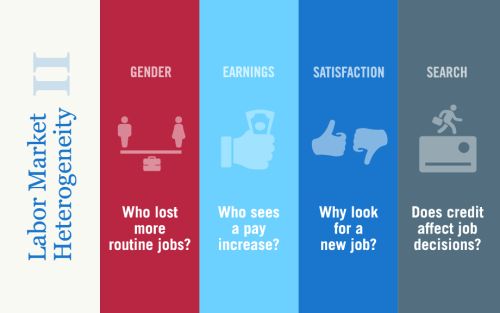
Rajashri Chakrabarti introduces a new Liberty Street Economics series exploring dimensions of heterogeneity in the labor market experience of U.S. workers.
Posted at 7:00 am in Human Capital, Inequality, Labor Market, Regional Analysis, Unemployment | Permalink | Comments (2)
February 13, 2020
Firm‑Level Shocks and GDP Growth: The Case of Boeing’s 737 MAX Production Pause

Events specific to large firms can have significant effects on the macroeconomy. The recent pause in Boeing’s 737 MAX production is a striking example of such an event or “shock.” This post provides a back-of-the envelope calculation of how the “737 MAX shock” could impact U.S. GDP growth in the first quarter of 2020.
Posted at 7:00 am in Macroeconomics | Permalink
 RSS Feed
 Follow Liberty Street Economics
