











There has been a lot of interest in how tariffs affect consumer prices (for example, Cavallo et al. 2021, 2025). In this post, we present results from our new research paper that estimates the effects of the 2025-26 tariffs on retail consumer prices. We find that for every percentage point increase in average tariffs, consumer goods prices increase by about a quarter of a percent after one year. Roughly two-thirds of the effect arises because tariffs raise the prices of imported consumer goods. The remaining third arises indirectly: tariffs increase the prices of goods made in the U.S. because producers pay more for imported parts and materials, and because producers raise their markups when competing imports cost more. The effects differ in their timing. Prices of imported goods respond quickly to tariffs, while prices of U.S.-made goods adjust over six to twelve months as higher costs move through the supply chain.
The Direct Effect: Tariffs Raise Import Prices Nearly One for One
A tariff raises the price a U.S. importer (which could be a firm or a consumer) pays for a foreign good, unless the foreign exporter cuts its price to absorb some of the cost. In a previous post, we found that foreign exporters lowered their prices very little, so that nearly 90 percent of the 2025 tariffs were passed through to U.S. import prices. We find the same result here using data through February 2026. The effect is immediate: import prices rise almost one for one with tariffs in the first month after a tariff is raised. Our conclusion is unchanged when we account for exchange-rate movements: the dollar depreciated over this period, which also raised import prices, but we still estimate a tariff pass-through of around 90 percent.
The Indirect Effect: Higher Domestic Producer Prices
Tariffs also affect the prices of goods made in the U.S. This happens in two ways. First, many U.S. producers rely on imported parts and materials, so tariffs raise their cost of production. For example, a tariff on steel makes it more expensive to build a car in the U.S. We refer to this effect as the marginal cost channel. Second, when tariffs make imported goods more expensive, U.S. producers of competing goods face less pressure to keep their own prices down. We refer to this effect as the strategic complementarity channel. We find evidence that U.S. producers increased their prices at the factory gate because of both channels, and the marginal cost effect is the larger of the two.
Unlike the response of import prices, the tariffs’ effect on U.S. producer prices takes time. In the first six months after a tariff is raised, U.S. producer prices rise only a little. The response then builds, roughly doubling over the following six months.
Pass-Through from Producer and Import Prices into Retail Prices Is about 50 Percent
The effects of tariffs on import and producer prices capture only what happens before goods reach the retail stage. Consumers pay the retail price, which must also cover distribution costs such as transportation, wholesaling, and retailing. These distribution margins account for about half of what consumers pay for goods. We next estimate how tariff-induced changes in import and domestic producer prices pass through to retail prices. We find that a 10 percent increase in import and producer prices due to tariffs raises consumer retail prices by 5.6 percent.
To understand this result, suppose a good retails for $100, of which $50 is the price at the border or factory gate and $50 is the distribution margin. If a tariff raises the producer price by 10 percent, to $55, and the distribution margin remains unchanged, the retail price rises to $105, an increase of 5 percent, close to the 5.6 percent we estimate.
The Total Effect: Higher Consumer Prices
To illustrate how the three results combine, we consider a scenario in which a 10 percent tariff is imposed on all imports. We estimate that in this case consumer goods prices would be 2.6 percent higher after twelve months, or about a quarter of the tariff increase. About two-thirds of this effect is direct, driven by higher prices of imported consumer goods. The remaining third is the indirect effect from U.S.-made goods, most of it from the marginal cost channel.
This consumer price increase does not arrive all at once. The direct effect of higher import prices comes through quickly: about half is in place after three months and all of it by six months, as retailers take a few months to pass on higher costs. In contrast, the indirect tariff effects from higher domestic producer prices take longer to appear. The size of the indirect effect on retail prices more than doubles between six and twelve months as U.S. producers raise their prices. The full effect on consumer prices is reached only after about a year.
The 2025-26 Tariffs and Consumer Goods Prices
Using our estimated tariff pass-through rates, we can gauge the size of the price pressures operating through the three channels described above. Our estimates compare price changes across non-oil consumer goods with higher and lower tariff exposure. The sample excludes services, which account for about two-thirds of the consumer basket. These comparisons help separate tariff-related price increases from broader movements in prices, but cannot establish how much of those broader movements was itself caused by tariffs. We therefore calculate what consumer goods price inflation would have been without these tariff effects, holding fixed economy-wide factors, such as exchange rates, wages, consumer demand, and monetary policy. Tariffs may also affect these economy-wide factors in ways that amplify or offset the price pressures we estimate.
In the chart below, the solid line shows the twelve-month change in consumer goods prices, and the dashed line shows the counterfactual without tariffs. Goods price inflation was back near its slightly negative pre-COVID average for most of 2024 and began to edge up late that year, before the new tariffs were introduced. It then picked up through 2025. Our estimates attribute this increase to the tariffs: by February 2026, tariffs had contributed 2.9 percentage points to goods price inflation, and without them goods prices would have fallen slightly.
Tariffs Raised Consumer Goods Price Inflation
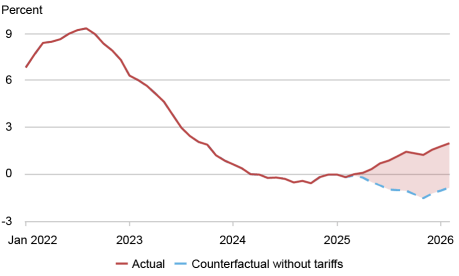
Notes: The solid line is the twelve-month change in consumer prices for the sixty-seven non-oil goods categories in our sample, weighted by 2022 consumer expenditure. The dashed line subtracts our estimate of the contribution of tariffs, shown by the shaded area. The estimates compare goods that were more exposed to tariffs with goods that were less exposed, holding economy-wide factors fixed.
The Tariff Effect on Consumer Goods Inflation Has Peaked, but the Price Level Stays Higher
Next, we provide a forecast beyond our sample, extending through September 2027, twelve months after our latest tariff data. We assume tariffs remain at their end-of-September 2026 levels, except for the announced January 2027 tariff increase on Canadian cars, trucks, and auto parts. The chart below shows the effect of tariffs on the level of consumer goods prices in the left panel and on their twelve-month change in the right panel, split into the direct effect (blue), the marginal cost effect (lighter gold), and strategic complementarity (darker gold).
Tariff Effects on Consumer Goods Prices Peaked in February 2026
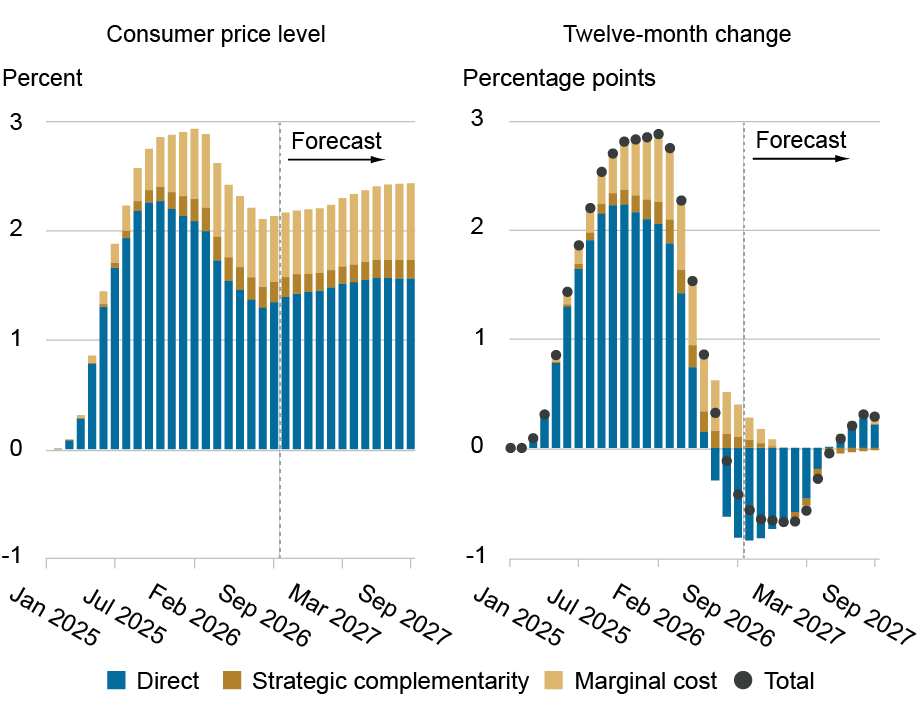
Notes: The left panel shows the estimated effect of the tariffs imposed since January 2025 on the level of consumer goods prices, and the right panel shows their contribution to the twelve-month change. Each bar is split into the direct effect, the marginal cost effect, and strategic complementarity. The analysis uses actual tariffs through September 2026, marked by the dashed line. The forecast starts in October 2026. It holds tariffs at their end-of-September 2026 levels, apart from the announced January 2027 tariff increase on Canadian cars, trucks, and auto parts. The black round dot in the right panel depicts the total predicted twelve-month change.
The left panel shows that the tariff effect on the consumer goods price level peaked near 3 percent in February 2026. Most of the initial price effect came from the direct channel, with the marginal cost and strategic complementarity channels taking more time to build. By February 2026, the indirect effect accounted for about 30 percent of the total price effect.
Our forecast shows the tariff effect on the goods price level easing to about 2 percent by August 2026. The easing reflects a cut in tariffs in early 2026, when a U.S. Supreme Court ruling ended the tariffs imposed under emergency powers and a lower 10 percent surcharge replaced them. Most of the decline is in the direct effect, while the indirect effect is more persistent because U.S. producer prices adjust slowly. After August 2026, the tariff effect on the price level edges up again. About half of that rise comes from tariff changes already in place, mainly the August 2026 tariffs on Canadian goods, which are still passing through. The rest reflects the tariff increase on Canadian autos announced for January 2027.
The right panel shows what this means for twelve-month changes in consumer goods prices. The contribution of tariffs peaked in February 2026, at 2.9 percentage points, and is forecast to fall to around zero by August 2026. It then turns negative as the large tariff increases of 2025 drop out of the twelve-month comparison, before turning slightly positive by mid-2027 as the Canadian tariffs pass through. Taken together, the two panels show that tariffs have left consumer goods price levels higher, while their effect on inflation fades.
In sum, we estimate that about a quarter of a tariff increase is passed through to consumer goods prices. Importantly, tariffs also raise the prices of goods that are not directly taxed: goods made in the U.S. account for about a third of the total effect. This indirect effect takes longer to materialize than the direct effect on imported goods, so the full effect of a tariff takes about a year to appear.

Mary Amiti is head of Labor and Product Markets in the Federal Reserve Bank of New York’s Research and Statistics Group.

Sebastian Heise is a research economist in the Federal Reserve Bank of New York’s Research and Statistics Group.
David E. Weinstein is an economics professor at Columbia University.
This post will be co-published, with minor changes, on VoxEU.org.
How to cite this post:
Mary Amiti, Sebastian Heise, and David E. Weinstein, “How Fast Do Tariffs Pass Through into Consumer Prices?,” Federal Reserve Bank of New York Liberty Street Economics, October 6, 2026, https://doi.org/10.59576/lse.20261006
BibTeX: View |


Disclaimer
The views expressed in this post are those of the author(s) and do not necessarily reflect the position of the Federal Reserve Bank of New York or the Federal Reserve System. Any errors or omissions are the responsibility of the author(s).

 RSS Feed
 Follow Liberty Street Economics

Thank you for this. I suppose your conclusion, that about a quarter of tariff increases are passed on to consumer prices (which are roughly consistent with my own work) may be because only half of merchandise is comprised of consumer items. The rest, like industrial materials is purchased by businesses and may come through the cost structure more slowly? We’re wondering what percentage of IREPA tariff refunds will be passed back to consumers, which will remove some of the heat from tariffs for a while. Good work