










102 posts on "Inequality"
October 7, 2019
Introduction to Heterogeneity Series: Understanding Causes and Implications of Various Inequalities
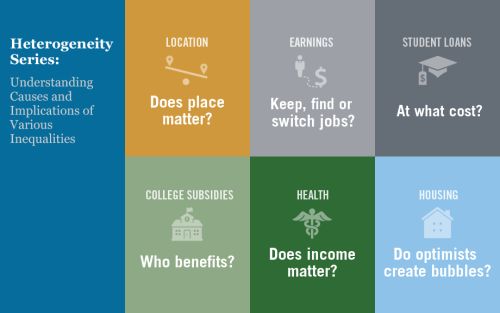
Economic analysis is often geared toward understanding the average effects of a given policy or program. Likewise, economic policies frequently target the average person or firm. While averages are undoubtedly useful reference points for researchers and policymakers, they don’t tell the whole story: it is vital to understand how the effects of economic trends and government policies vary across geographic, demographic, and socioeconomic boundaries. It is also important to assess the underlying causes of the various inequalities we observe around us, be they related to income, health, or any other set of indicators. Starting today, we are running a series of six blog posts (apart from this introductory post), each of which focuses on an interesting case of heterogeneity in the United States today.
Posted at 7:00 am in Education, Equitable Growth, Household Finance, Inequality, Labor Market, Regional Analysis | Permalink
July 10, 2019
Did the Value of a College Degree Decline during the Great Recession?

In an earlier post, we studied how educational attainment affects labor market outcomes and earnings inequality. In this post, we investigate whether these labor market effects were preserved across the last business cycle: Did students with certain types of educational attainment weather the recession better?
Posted at 7:00 am in Education, Human Capital, Inequality, Labor Market, Recession | Permalink | Comments (5)
September 5, 2018
Education’s Role in Earnings, Employment, and Economic Mobility

Amid dialogue about the soaring student loan burden, questions arise about how educational characteristics (school type, selectivity, and major) affect disparities in post-college labor market outcomes. In this post, we specifically explore the impact of such school and major choices on employment, earnings, and upward economic mobility. Insight into determinants of economic disparity is key for understanding long-term consumption and inequality patterns. In addition, this gives us a window into factors that could be used to ameliorate income inequality and promote economic mobility.
Posted at 7:00 am in Education, Equitable Growth, Human Capital, Inequality, Labor Market | Permalink
June 27, 2018
Why New York City Subway Delays Don’t Affect All Riders Equally
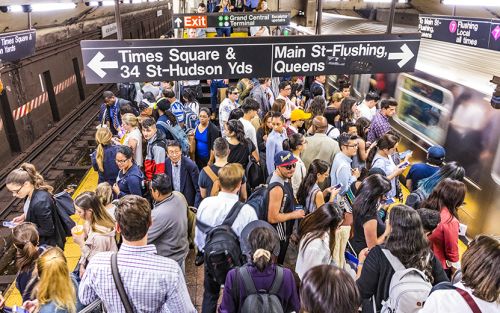
The state of the New York City subway system has worsened considerably over the past few years. As a consequence of rising ridership and decaying infrastructure, the network is plagued by delays and frequently fails to deliver New Yorkers to their destinations on time. While these delays are a headache for anyone who depends on the subway to get around, they do not affect all riders in the same way. In this post, we explain why subway delays disproportionately affect low-income New Yorkers. We show that wealthier commuters who rely on the subway are less likely to experience extensive issues on their commutes.
April 4, 2018
Do the Employed Get Better Job Offers?

In a previous post, we examined the job search behavior of workers, both on the job and while unemployed. We found that job seeking is pervasive among employed workers, and that searching while employed is more effective than searching while unemployed in producing employer contacts and job offers. But how do the offers received through “on the job” search compare to those received while unemployed? What do their wages look like, how do they compare in terms of nonwage benefits, and how much bargaining between employers and job applicants is involved? In this post, we shed some light on how job offers may vary depending on the employment status of the job seeker.
February 16, 2017
The Homeownership Gap Is Finally Closing

The homeownership rate peaked at 69 percent in late 2004. By the summer of 2016, it had dropped below 63 percent—exactly where it was when the government started reporting these data back in 1965.
February 14, 2017
The Evolution of Home Equity Ownership

In yesterday’s post, we discussed the extreme swings that household leverage has taken since 2005, using combined loan-to-value (CLTV) ratios for housing as our metric. We also explored the risks that current household leverage presents in the event of a significant downturn in prices. Today we reverse the perspective, and consider housing equity—the value of housing net of all debt for which it serves as collateral. For the majority of households, housing equity is the principal form of wealth, other than human capital, and it thus represents an important form of potential collateral for borrowing. In that sense, housing equity is an opportunity in the same way that housing leverage is a risk. It turns out that aggregate housing equity at the end of 2015 was very close, in nominal terms, to its pre-crisis (2005) level. But housing wealth has moved to a different group of people—made up of people who are older and have higher credit scores than a decade ago. In today’s post, we look at the evolution of housing equity and its owners.
August 3, 2016
The Reluctance of Firms to Interview the Long‑Term Unemployed

Estimates from the Current Population Survey show that the probability of finding a job declines the longer one is unemployed.
November 6, 2015
Health Inequality
However important income inequality is, it is only a partial representation of the inequality in well-being among individuals, households, counties, and other communities.
November 5, 2015
How Did Quantitative Easing Interact with Regional Inequality?
Income, or wealth, inequality is not something that central bankers generally worry about when setting monetary policy, the goals of which are to maintain price stability and promote full employment.
Posted at 7:05 am in Household Finance, Housing, Inequality, Macroeconomics, Monetary Policy, Regional Analysis, Unemployment | Permalink
 RSS Feed
 Follow Liberty Street Economics
