










102 posts on "Inequality"
March 4, 2020
Is the Tide Lifting All Boats? A Closer Look at the Earnings Growth Experiences of U.S. Workers
Although there is evidence that U.S. workers at the bottom of the earnings distribution may be catching up with those at the top, there are indications that returns to higher education may be increasing, with earnings growth for college graduates outpacing those with less education.
Women Have Been Hit Hard by the Loss of Routine Jobs, Too
Jaison Abel and Richard Deitz find that although both men and women have experienced a loss of routine jobs since 2000, the decline has been markedly steeper for women.
March 3, 2020
Introduction to Heterogeneity Series II: Labor Market Outcomes
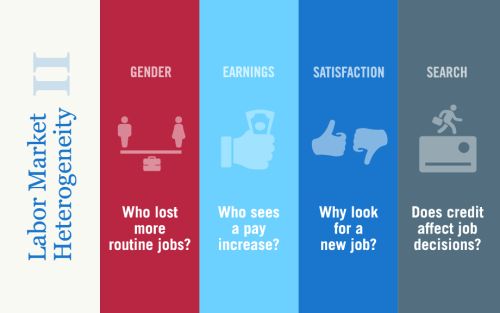
Rajashri Chakrabarti introduces a new Liberty Street Economics series exploring dimensions of heterogeneity in the labor market experience of U.S. workers.
Posted at 7:00 am in Human Capital, Inequality, Labor Market, Regional Analysis, Unemployment | Permalink | Comments (2)
February 24, 2020
Understanding Heterogeneous Agent New Keynesian Models: Insights from a PRANK

To shed light on the macroeconomic consequences of heterogeneity, Acharya and Dogra develop a stylized HANK model that contains key features present in more complicated HANK models.
Posted at 7:00 am in Central Bank, Credit, Federal Reserve, Financial Institutions, Fiscal Policy, Inequality, Macroeconomics, Monetary Policy, Recession, Systemic Risk | Permalink
October 16, 2019
Optimists and Pessimists in the Housing Market
Haoyang Liu and Christopher Palmer examine how perceptions of past housing prices may shape predictions for the future, and investigate whether these tendencies shape participation in the housing market.
October 15, 2019
Does U.S. Health Inequality Reflect Income Inequality—or Something Else?
Health is an integral part of well-being. The United Nations Human Development Index uses life expectancy (together with GDP per capita and literacy) as one of three key indicators of human welfare across the world. In this post, I discuss the state of life expectancy inequality in the United States and examine some of the underlying factors in its evolution over the past several decades.
Posted at 7:01 am in Inequality | Permalink
October 10, 2019
Is Free College the Solution to Student Debt Woes? Studying the Heterogeneous Impacts of Merit Aid Programs
The rising cost of a college education has become an important topic of discussion among both policymakers and practitioners. At least eleven states have recently introduced programs to make public two-year education tuition free, including New York, which is rolling out its Excelsior Scholarship to provide tuition-free four-year college education to low-income students across the SUNY and CUNY systems. Prior to these new initiatives, many states, including New York, had already instituted merit scholarship programs that subsidize the cost of college conditional on academic performance and in-state attendance. Given the rising cost of college and the increased prevalence of tuition-subsidy programs, it’s important for us to understand the effects of such programs on students, and whether these effects vary by income and race. While a rich body of work has studied the effects of merit scholarship programs on educational attainment, the same is not true for the effects on financial outcomes of students, such as debt and repayment. This blog post reports preliminary findings from ongoing work, which is one of the first research initiatives to understand such effects.
October 9, 2019
Who Borrows for College—and Who Repays?
Student loans are increasingly a focus of discourse among politicians, policymakers, and the news media, resulting in a range of new ideas to address the swelling aggregate debt. Evaluating student loan policy proposals requires understanding the challenges faced by student borrowers. In this post, we explore the substantial variation in the experiences of borrowers and consider the distributional effects of various policy options.
October 8, 2019
Job Ladders and Careers
Workers in the United States experience vast differences in lifetime earnings. Individuals in the 90th percentile earn around seven times more than those in the 10th percentile, and those in the top percentile earn almost twenty times more. A large share of these differences arise over the course of people’s careers. What accounts for these vastly different outcomes in the labor market? Why do some individuals experience much steeper earnings profiles than others? Previous research has shown that the “job ladder”—in which workers obtain large pay increases when they switch to better jobs or when firms want to poach them—is important for wage growth. In this post, we investigate how job ladders differ across workers.
October 7, 2019
Some Places Are Much More Unequal than Others
Economic inequality in the United States is much more pronounced in some parts of the country than others. In this post, we examine the geography of wage inequality, drawing on our recent Economic Policy Review article. We find that the most unequal places tend to be large urban areas with strong economies where wage growth has been particularly strong for those at the top of the wage distribution.
 RSS Feed
 Follow Liberty Street Economics
