










258 posts on "Macroeconomics"
November 28, 2016
At the N.Y. Fed: Convening on the Evolution of Work
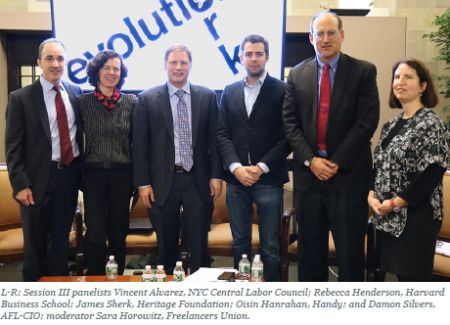
Nora Fitzpatrick, Laura Pilossoph, Anika Pratt, and Aysegul Sahin The Federal Reserve Bank of New York recently hosted “The Evolution of Work,” a conference that brought together thought leaders from academia, government, industry, labor, and the nonprofit sector to explore how the nature of work is evolving, including the expanding role of technology, shifts in […]
November 21, 2016
The FRBNY DSGE Model Forecast—November 2016
This post presents the latest update of the economic forecasts generated by the Federal Reserve Bank of New York’s (FRBNY) dynamic stochastic general equilibrium (DSGE) model.
Posted at 7:00 am in DSGE, Expectations, Forecasting, Macroeconomics, Monetary Policy | Permalink | Comments (2)
November 14, 2016
Inflation and Japan’s Ever‑Tightening Labor Market

Japan offers a preview of future U.S. demographic trends, having already seen a large increase in the population over 65.
Posted at 7:00 am in International Economics, Labor Market, Macroeconomics, Unemployment | Permalink | Comments (2)
September 9, 2016
Now on Your iPhone: The Economic Research Tracker
The Federal Reserve Bank of New York today announced the launch of its Economic Research Tracker app for the iPhone®. The app, which highlights the insights and analysis of New York Fed economists, was first introduced last year for the iPad®. Today’s launch makes the app even more accessible to readers.
Posted at 7:00 am in Macroeconomics | Permalink
August 19, 2016
Historical Echoes: That’s Where the Celebrity Advertising Was, or the Gentleman Bank Robber
In 1970, New Britain Bank and Trust (inactive as of 1984) ran a television advertisement that starred a real-life bank robber touting a safety feature of its new “face card.” (A History Channel video includes interesting preliminaries about how the journalists obtained the ad; the ad itself starts at 5:44.) Why would this bank be willing to create such an ad? Of course, neither this bank, nor any other bank, nor any Federal Reserve Bank would condone the act of robbing a bank. But this particular thief, the notorious Willie Sutton (1901-80), was different from typical bank robbers. Let’s consider why:
August 15, 2016
What Drives Forecaster Disagreement about Monetary Policy?

What can disagreement teach us about how private forecasters perceive the conduct of monetary policy? In a previous post, we showed that private forecasters disagree about both the short-term and the long-term evolution of key macroeconomic variables but that the shape of this disagreement differs across time. In contrast to their views on other macroeconomic variables, private forecasters disagree substantially about the level of the federal funds rate that will prevail in the medium to long term but very little on the rate at shorter horizons. In this post, we explore the possible explanations for what drives forecasts of the federal funds rate, especially in the longer run.
Posted at 7:00 am in Forecasting, Inflation, Macroeconomics, Monetary Policy | Permalink | Comments (1)
August 3, 2016
The Reluctance of Firms to Interview the Long‑Term Unemployed

Estimates from the Current Population Survey show that the probability of finding a job declines the longer one is unemployed.
June 24, 2016
Just Released: May’s Indexes of Coincident Economic Indicators Show Economic Growth Moderating across the Region
The May Indexes of Coincident Economic Indicators (CEIs) for New Jersey, New York State, and New York City, released today, show some slowing in economic growth across the region—in part reflecting the Verizon strike (which has since been settled), as well as somewhat weaker economic fundamentals.
May 25, 2016
The Macro Effects of the Recent Swing in Financial Conditions
Credit conditions tightened considerably in the second half of 2015 and U.S. growth slowed. We estimate the extent to which tighter credit conditions last year were responsible for the slowdown using the FRBNY DSGE model. We find that growth would have slowed substantially more had the Federal Reserve not delayed liftoff in the federal funds rate.
May 23, 2016
The FRBNY DSGE Model Forecast—May 2016
The May 2016 forecast of the Federal Reserve Bank of New York’s (FRBNY) dynamic stochastic general equilibrium (DSGE) model remains broadly in line with those of our two previous semiannual reports (see our May 2015 and December 2015 posts). In the past year, the headwinds that contributed to slower growth in the aftermath of the financial crisis finally began to abate. However, the widening of credit spreads associated with swings in financial markets in the second half of 2015 and the first few months of this year have had a negative impact on economic activity. Despite this setback, the model expects a rebound in growth in the second half of the year, so that the medium-term forecast remains, as in the December post, one of steady, gradual economic expansion. The model also continues to predict gradual progress in the inflation rate toward the Federal Open Market Committee’s (FOMC) long-run target of 2 percent.
 RSS Feed
 Follow Liberty Street Economics
