










205 posts on "Monetary Policy"
February 17, 2017
The FRBNY DSGE Model Forecast—February 2017
This post presents the latest update of the economic forecasts generated by the Federal Reserve Bank of New York’s (FRBNY) dynamic stochastic general equilibrium (DSGE) model. We introduced this model in a series of blog posts in September 2014 and published forecasts twice a year thereafter. With this post, we move to a quarterly release schedule, and highlight how our forecasts have changed since November 2016.
Readers should keep in mind that the DSGE model forecast is not an official New York Fed forecast, but only an input to the Research staff’s overall forecasting process. For more information about the model and the variables discussed here, see our DSGE Model Q & A.
December 21, 2016
Hey, Economist! Tobias Adrian Reflects on His Work at the N.Y. Fed before Heading to the IMF

Tobias Adrian is leaving the New York Fed to become the Financial Counselor and Director of the Monetary and Capital Markets Department at the International Monetary Fund (IMF). In announcing Adrian’s appointment, Christine Lagarde, managing director of the IMF, described Tobias as “internationally highly regarded for his insightful analytical work.” Until he starts his new position at the beginning of 2017, Adrian will be winding down his service as Senior Vice President of the New York Fed and Associate Director of the Bank’s Research and Statistics Group. Before he moves on to the IMF, Adrian shared some insight on his time at the Bank.
December 20, 2016
At the N.Y. Fed: Capital Flows, Policy Dilemmas, and the Future of Global Financial Integration
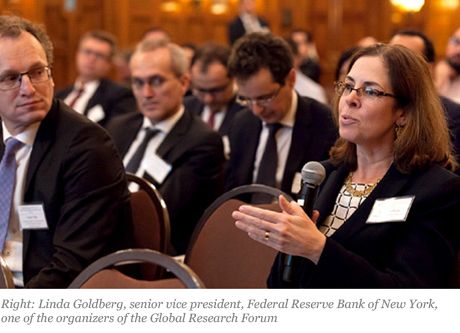
The New York Fed recently hosted the third bi-annual Global Research Forum on International Macroeconomics and Finance, an event organized in conjunction with the European Central Bank (ECB) and the Federal Reserve Board. Bringing together a diverse group of academics, policymakers, and market participants, the two-day conference (November 17-18) was aimed at promoting discussion of frontier research on empirical and theoretical issues in international finance, banking, and open-economy macroeconomics. Understanding the drivers and implications of international capital flows was a major area of focus, along with the policy challenges posed by global financial integration.
Posted at 7:00 am in Financial Markets, International Economics, Macroeconomics, Monetary Policy | Permalink
November 21, 2016
The FRBNY DSGE Model Forecast—November 2016
This post presents the latest update of the economic forecasts generated by the Federal Reserve Bank of New York’s (FRBNY) dynamic stochastic general equilibrium (DSGE) model.
Posted at 7:00 am in DSGE, Expectations, Forecasting, Macroeconomics, Monetary Policy | Permalink | Comments (2)
November 16, 2016
Escaping Unemployment Traps

Economic activity has remained subdued following the Great Recession. One interpretation of the listless recovery is that recessions inflict permanent damage on an economy’s productive capacity. For example, extended periods of high unemployment can lead to skill losses among workers, reducing human capital and lowering future output. This notion that temporary recessions have long-lasting consequences is often termed hysteresis. Another explanation for sluggish growth is the influential secular stagnation hypothesis, which attributes slow growth to long-term changes in the economy’s underlying structure. While these explanations are observationally similar, they have very different policy implications. In particular, if structural factors are responsible for slow growth, then there might be little monetary policy can do to reverse this trend. If instead hysteresis is to blame, then monetary policy may be able to reverse slowdowns in potential output, or even prevent them from occurring in the first place.
September 30, 2016
From the Vault: Does Forward Guidance Work?
This post takes a look at research assessing the effectiveness of forward guidance in monetary policy communications.
August 15, 2016
What Drives Forecaster Disagreement about Monetary Policy?

What can disagreement teach us about how private forecasters perceive the conduct of monetary policy? In a previous post, we showed that private forecasters disagree about both the short-term and the long-term evolution of key macroeconomic variables but that the shape of this disagreement differs across time. In contrast to their views on other macroeconomic variables, private forecasters disagree substantially about the level of the federal funds rate that will prevail in the medium to long term but very little on the rate at shorter horizons. In this post, we explore the possible explanations for what drives forecasts of the federal funds rate, especially in the longer run.
Posted at 7:00 am in Forecasting, Inflation, Macroeconomics, Monetary Policy | Permalink | Comments (1)
July 15, 2016
Implementing Monetary Policy Post‑Crisis: What Do We Need to Know?
Columbia University’s School of International and Public Affairs and the New York Fed co-sponsored a recent workshop to discuss important issues related to monetary policy implementation. The May 4 event, held at Columbia, supports the extended effort that the Federal Reserve has undertaken to evaluate potential long-run monetary policy implementation frameworks, which was announced at a Federal Open Market Committee meeting last July.
Posted at 7:00 am in Monetary Policy | Permalink
June 29, 2016
Monetary Policy Transmission before and after the Crisis

The Federal Open Market Committee implements monetary policy by raising or lowering its target for the federal funds rate, the interest rate banks charge each other for overnight loans.
June 22, 2016
The Rapidly Changing Nature of Japan’s Public Debt
Japan’s general government debt-to-GDP ratio is the highest of advanced economies, due in part to increased spending on social services for an aging population and a level of GDP that has not increased for two decades.
Posted at 7:00 am in Bank Capital, Exchange Rates, Fiscal Policy, Monetary Policy | Permalink | Comments (6)
 RSS Feed
 Follow Liberty Street Economics
