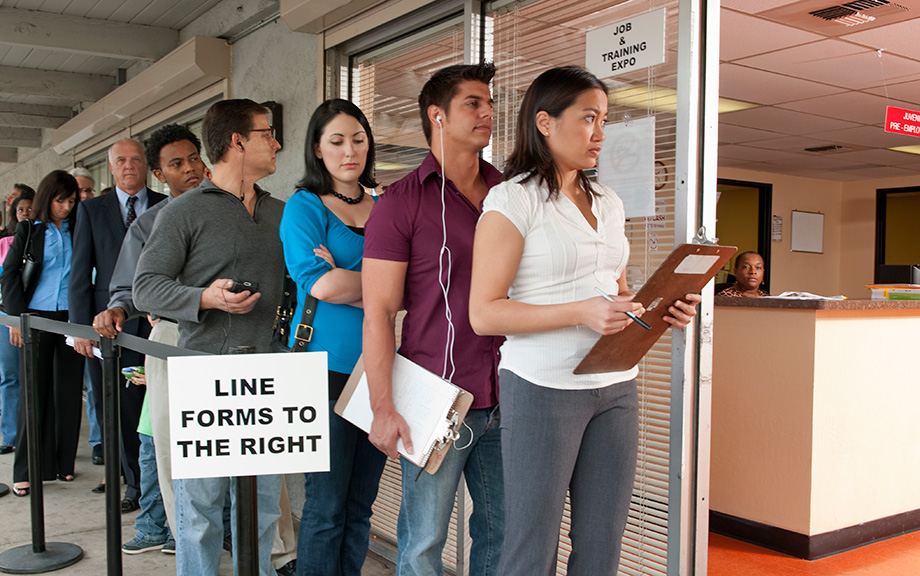





Stefania Albanesi, Ayşegül Şahin, and Joshua Abel*The contrasting movements in the employment-to-population ratio (E/P) and the unemployment rate recently have been striking and puzzling. The unemployment rate has declined 1.7 percentage points since the unemployment peak in October 2009, but the E/P ratio has increased only 0.1 percentage point.
Continue reading "Reconciling Contrasting Signals in the Labor Market: The Role of Participation" »
Amy Farber* and Andrew Haughwout
The measurement of employment and unemployment in the United States has a long history—longer, in fact, than that of other measures of economic activity. The U.S. Bureau of Labor Statistics (BLS) was established in 1884, twenty-five years before the creation of national income accounting and the measurement of GDP.
Continue reading "Historical Echoes: How the BLS Measured Up" »
Argia M. SbordoneThis week, Federal Reserve Chairman Ben Bernanke completed his four-lecture series for undergraduate students at the George Washington School of Business in Washington, D.C. The lectures have been part of the Chairman’s ongoing effort to educate the public about the Federal Reserve and the role it played during the recent financial crisis. Building upon last week’s broad overview of the origin and mission of central banks and the lessons learned from previous financial crises, this week’s lectures—presented on March 27 and 29—centered on the financial crisis that emerged in 2007. The Chairman discussed the build-up of the crisis and the actions taken by the Federal Reserve and other central banks to address the financial crisis and the ensuing recession.
Continue reading "Just Released: Chairman Bernanke Returns to His Academic Roots, Part 2" »
Richard Crump and Ayşegül Şahin Recessions and recoveries typically have been times of substantial reallocation in the economy and the labor market, and the current cycle does not appear to be an exception. The speed and smoothness of reallocation depend in part on the structure of the labor market, particularly the degree of mismatch between the characteristics of available workers and newly available jobs. Such mismatches could occur because of differences in skills between workers and jobs (skills mismatch) or because of differences in the location of the available jobs and available workers (geographic mismatch). In this post, we focus on skills mismatch to assess the extent to which the slow pace of the labor market recovery from the Great Recession can be attributed to such problems. If skills mismatch is much more severe than usual, we would expect the unemployment rate to remain higher for longer and the workers subject to such mismatch to have worse labor market outcomes.
Continue reading "Skills Mismatch, Construction Workers, and the Labor Market" »
Ayşegül Şahin and Christina Patterson*
An alternative to Okun’s law to understand unemployment dynamics is to examine the evolution of the unemployment inflow and outflow rates. (For more on Okun’s law, see yesterday’s post.) A useful analogy is a bathtub: we can think of the unemployment rate (a stock) as the amount of water in a bathtub. Changes in the amount of water in the tub are determined by the rate at which water pours into the tub relative to the rate at which it drains out. For example, if the inflow of water is equal to the outflow, the amount of water in the tub remains constant. But if the rate of water flow into the tub is suddenly increased by turning the faucet to its maximum level, then the water level rises rapidly. A similar dynamic occurs in the stock of unemployed workers when there is a rapid increase in job losses during a recession. In this post, we focus on the flow dynamics in an economic recovery to help understand how the unemployment rate may evolve.
Continue reading "The Bathtub Model of Unemployment: The Importance of Labor Market Flow Dynamics" »
Jonathan McCarthy, Simon Potter, and Ging Cee Ng*Economic forecasters frequently use a simple rule of thumb called
Okun’s law to link their real GDP growth forecasts to their unemployment rate forecasts. While they recognize that temporary deviations from Okun’s law may occur, forecasters often assume that sustained reductions in the unemployment rate require robust GDP growth. However, our analysis suggests that Okun’s law has not been a consistently reliable tool for predicting the size of declines in the unemployment rate during the last three expansions—a finding that reflects the impact of changes in the labor market since the early 1960s. We also find that the percentage declines in the unemployment rate over the third through fifth years of the last three expansions have been strikingly similar—a pattern that suggests an important role for flows into and out of unemployment in explaining movements in the unemployment rate, the subject of tomorrow’s blog post.
Continue reading "Okun’s Law and Long Expansions" »
Jonathan McCarthy and Simon PotterThe unemployment rate in the United States fell from 9.1 percent in the summer of 2011 to 8.3 percent in February. This decline, the largest six-month drop in the unemployment rate since 1984, has surprised many economic forecasters. The decline is even more surprising because recent real GDP growth appears to have been around trend at best, whereas in early 1984, growth was more than 7 percent. Our next six posts in
Liberty Street Economics will discuss prospects for the U.S. labor market given this surprisingly quick decline in the unemployment rate. In this opening post, we outline some of the themes examined in this series and provide a brief summary of our conclusions. But first we develop a simple framework to place the unemployment rate in context with the rest of the labor market.
Continue reading "Prospects for the U.S. Labor Market" »
Argia M. SbordoneFederal Reserve Chairman Ben Bernanke is back in the classroom this month to deliver a series of four lectures for undergraduate students at the George Washington School of Business in Washington, D.C. It’s a welcome reconnection with students for Chairman Bernanke, who joined the Federal Reserve System in 2002 after a long career as an economics professor at Stanford University and later at Princeton University. The lectures at the George Washington School are part of Bernanke’s ongoing effort to educate the public about the role played by the Federal Reserve during the recent financial crisis. The nature and the scope of these lectures allow the Chairman to draw upon his background as a scholar of the Great Depression and his experience at the helm of the U.S. central bank to put the financial crisis in a broader context. The Chairman will talk about the origins and mission of central banks, identify the lessons learned from previous financial crises, and describe how those lessons informed the Fed's decisions during the recent crisis.
Continue reading "Just Released: Chairman Bernanke Returns to His Academic Roots" »
Joshua Abel* and Joseph Tracy
The foreclosure crisis in America continues to grow, with more than 3 million homes foreclosed since 2008 and another 2 million in the process of foreclosure. President Obama, in his
speech of February 2, 2012, argued for expanded refinancing opportunities for homeowners and programs to expedite the transition of foreclosed homes into rental housing. In this post, we document the changing face of foreclosures since 2006 and the transformation of the crisis from a subprime mortgage problem to a prime mortgage problem owing to the housing bust and persistent high unemployment. Recognizing this change is critical because the design of housing policies should reflect the types of homeowners who are at risk of foreclosure today rather than those who were at risk at the onset of the financial crisis.
Continue reading "The Changing Face of Foreclosures" »
Jason Bram and James Orr
The January
Indexes of Coincident Economic Indicators (
CEIs) for New York State, New York City, and New Jersey, released today, show fairly robust economic growth entering 2012. Importantly, this month’s release incorporates the annual benchmark employment revisions for 2010 and 2011, with the revised indexes revealing that the regional economy had more momentum in the second half of 2011 than previously thought.
Continue reading "Just Released: January’s Indexes of Coincident Economic Indicators Show Fairly Robust Activity across the Region" »