








119 posts on "Historical Echoes"
March 31, 2017
Historical Echoes: Noir Gold—The Case of the Brasher Doubloon
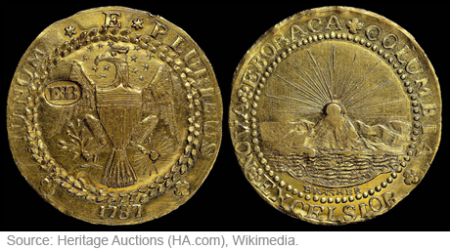
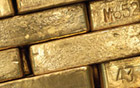
Whatever the vagaries of the market, gold is a perennially hot commodity in the popular imagination—especially in the minds of authors and screenwriters. In this Historical Echoes post, we take a look at Raymond Chandler’s 1942 Philip Marlowe novel The High Window, which uses a stolen gold coin—the Brasher Doubloon—as a plot device.
March 17, 2017
Historical Echoes: The Bank That Never Existed, or You Say ‘Immigrant’ and I Say ‘Emigrant’
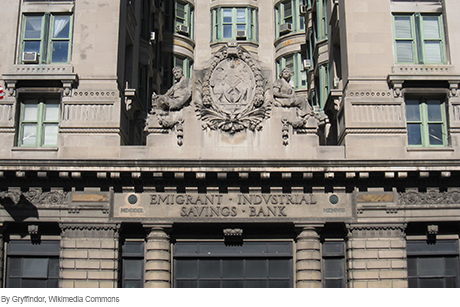
Just because an entity is referred to all over the place, does that mean it exists? We are not talking about heaven or hell. We are talking about the “Immigrant Savings Bank.”
March 3, 2017
Historical Echoes: That Pesky, Well‑Overdue Library Book
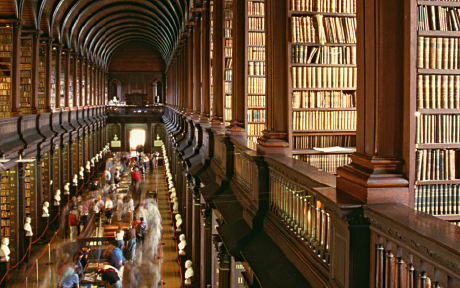
The “extremely overdue library book” has had a long run as a sitcom trope. As a source of humor, the ludicrously large library late fine pays off in at least two ways: first, there’s the enormity of the fine when compared with the insignificant monetary value of the book itself (paving the way for jokes about inflation and compound interest); and second, there’s the idea of the “criminality” of the offender, who is probably unlikely to commit any other kind of crime, with the concomitant image of “library police” (or actual police) coming after the negligent borrower . . . One day, that could be you, dear reader.
Posted at 7:00 am in Historical Echoes | Permalink
February 10, 2017
Historical Echoes: The Legacy of Freedman’s Savings and Trust
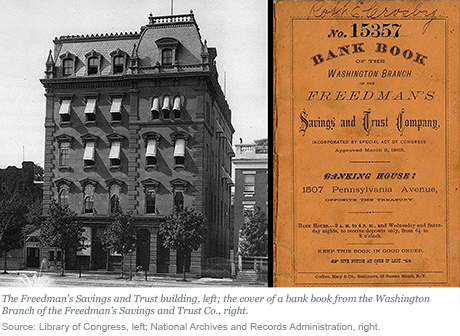
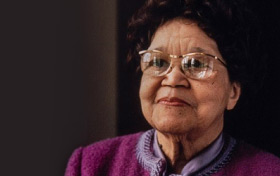
Freedman’s Savings and Trust Company, often referred to as the Freedman’s Bank, was created specifically for former slaves and African-American soldiers. It was established by legislation signed by Abraham Lincoln on March 3, 1865, only weeks before his assassination. Groundwork for the bank was laid during a meeting in January of that year by abolitionist preacher John Alvord, who met with a number of others to discuss the possibility of founding a system to assist freed African-Americans in their savings, financial development, and integration into American economic society. In the ten years of its existence, the Freedman’s Bank brought hope and then heartbreak to the African-American community.
Posted at 7:00 am in Historical Echoes | Permalink
January 20, 2017
Historical Echoes: Are There Any Banks on Bank Street?
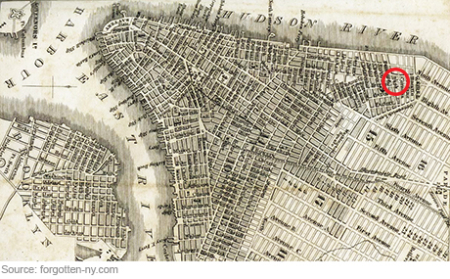
Bank Street in New York City is a quaint little six-block stretch in Greenwich Village (see this 48-second video) with a huge cultural legacy—but no banks. Many cities and towns have a Bank Street and often the street is so named because that’s where most of the banks were originally located. (It is not likely that any Bank Street got its name because of proximity to a riverbank.) However, New York City’s Bank Street is not where the banks were originally located and it’s not even in the financial district—it’s in Greenwich Village. Why, then, is it called “Bank Street?”
January 13, 2017
Historical Echoes: Tracking Money

Have you ever wondered where your dollars go when you spend them? Not in financial terms, but their physical location? Well, there’s an app and a website for that.
October 14, 2016
Historical Echoes: The Bank Teller Action Figure, or It’s All in the Packaging
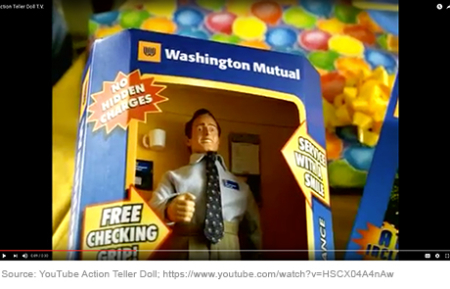
This is a story about a humorous bank ad that morphed into a promotional campaign. It’s a tale that shares themes with four previous Historical Echoes posts about Barbie, bank promotions, and bank tellers.
August 19, 2016
Historical Echoes: That’s Where the Celebrity Advertising Was, or the Gentleman Bank Robber
In 1970, New Britain Bank and Trust (inactive as of 1984) ran a television advertisement that starred a real-life bank robber touting a safety feature of its new “face card.” (A History Channel video includes interesting preliminaries about how the journalists obtained the ad; the ad itself starts at 5:44.) Why would this bank be willing to create such an ad? Of course, neither this bank, nor any other bank, nor any Federal Reserve Bank would condone the act of robbing a bank. But this particular thief, the notorious Willie Sutton (1901-80), was different from typical bank robbers. Let’s consider why:
July 15, 2016
Historical Echoes: The Fed’s Cuban Connection
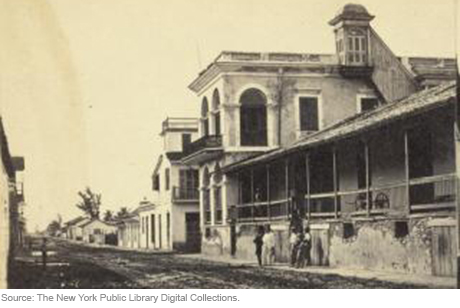
Did you know that the Federal Reserve once had not one, but two offices in Cuba?
May 20, 2016
Historical Echoes: When Fed Chairs Expound on Life
J.K. Rowling, David Byrne, Eric Idle—These captivating figures delivered commencement addresses at Harvard, Columbia University and Whitman College, respectively. Of course, Federal Reserve chairs give commencement speeches too, and good ones. NPR maintains a list of some standouts, “The Best Commencement Speeches, Ever” (this is a cool interactive website that enables you to search by name, school, year, or by theme—play, inner voice, embrace failure, change the world, make art, etc.). Its roundup of graduation season remarks includes Janet Yellen’s 2014 speech at New York University, and Ben Bernanke’s 2013 speech at Princeton. Another list, “Best Commencement Speeches Of All Time,” includes Alan Greenspan’s 1999 commencement speech at Harvard.
 RSS Feed
 Follow Liberty Street Economics