










In this post, we discuss insights from a recent staff report on the role of banking supervision in identifying and disciplining failing banks. We show that bank failures typically result from supervisory closure decisions based on hard information about book equity. Yet hard information is itself partly produced by supervision, as our evidence suggests that supervisors require troubled banks to recognize potential losses. We argue that supervision faces a trade-off: Stricter supervision can reduce the costs of resolving failing banks, but it can also lead to tighter regulatory capital constraints and hold back credit supply.
Role of Banking Supervision in Distressed Banks
Banking supervision seeks to safeguard the health of the financial system by monitoring financial institutions and enforcing regulatory compliance. Our analysis starts with the premise that supervision has two core economic purposes in dealing with distressed banks. The first is information production. Supervisors can verify hard information in banks’ financial statements, may force recognition of losses that might otherwise remain hidden, and produce soft information about loan quality and management. The second purpose is discipline. Once supervisors identify a weak bank, they can require loss recognition, force recapitalization, or close the bank.
In our recent staff report, we leverage supervisory data covering all commercial bank examinations from 2000 to 2023 to understand the role of banking supervision in distressed banks and resolving banking crises. In the following, we discuss some of our key insights.
Bank Closures Are Supervisory Decisions
The chart below shows the distribution of failure dates across weekdays for both failures in the contemporary banking system and from the historical, pre-federal-deposit insurance era. The gold bars show that, in the last few decades, banks almost always fail on Fridays, the Federal Deposit Insurance Corporation’s (FDIC’s) preferred bank closure day. Of all 557 commercial bank failures since 2000, only 28 banks failed on a day other than a Friday. Furthermore, when banks are closed, they are almost always purchased by another bank, with the purchase typically being arranged before failure occurs formally. Thus, although there are notable exceptions, modern bank failures are rarely triggered by market forces but instead follow a supervisory decision.
The fact that market forces such as deposit withdrawals rarely trigger bank closures is in line with deposit insurance and other government interventions affecting depositor behavior and market discipline. This logic is well illustrated by comparing the timing of bank failures in the contemporary banking system with the timing of failures in the historical U.S. banking system. Using data on bank failures between 1865 and 1935 that includes both the pre-Federal Reserve System and pre-FDIC eras, the chart below shows that failure dates were effectively uniformly distributed across weekdays before 1935. This pattern suggests that, before federal deposit insurance, bank owners or depositors typically determined the timing of a bank closure. This comparison of the timing of contemporary and historical failures also highlights how supervisory actions may partly substitute for the lack of depositor discipline, especially in the presence of deposit insurance.
Weekday of Bank Failures Pre- and Post-FDIC
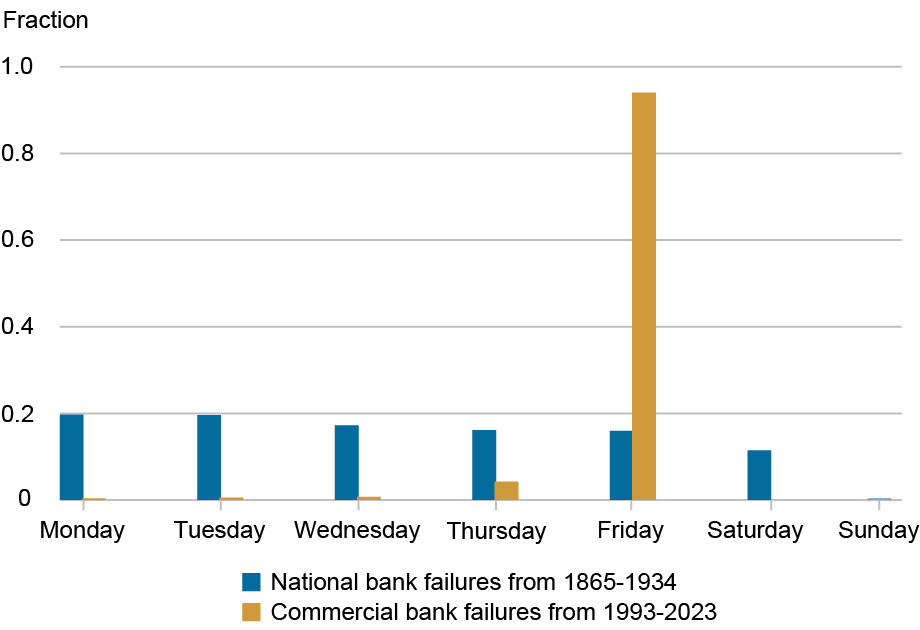
Notes: This chart plots the fraction of bank failures by the day of the week for both a pre-FDIC sample consisting of failed national banks from 1865 through 1935 and a sample of failed FDIC member banks from 1993 through 2023.
Supervisors Act Based on Hard Information
When do supervisors decide to close troubled banks? We next illustrate that bank closures tend to happen when banks have low reported book equity and are rated at being at risk of failure by supervisors. In other words, supervisors close banks based on hard information on a bank’s book equity.
To illustrate the importance of hard information for bank closures, the chart below correlates the probability that a bank fails within the following year with a bank’s regulatory capital ratio. We find that the probability of bank failure is closely tied to a bank’s reported equity-to-assets ratio, with bank closures being almost exclusively observed for banks with very low regulatory capital. For instance, while banks with an equity-to-assets ratio of above 5 percent effectively never fail, the probability of a bank getting closed over the following year increases rapidly as capitalization falls once a bank has an equity-to-assets ratio of less than 5 percent. If the ratio falls short of 2 percent, the probability of failure over the subsequent year goes up to almost 70 percent
Bank Closures, Corrective Action, and Regulatory Capital
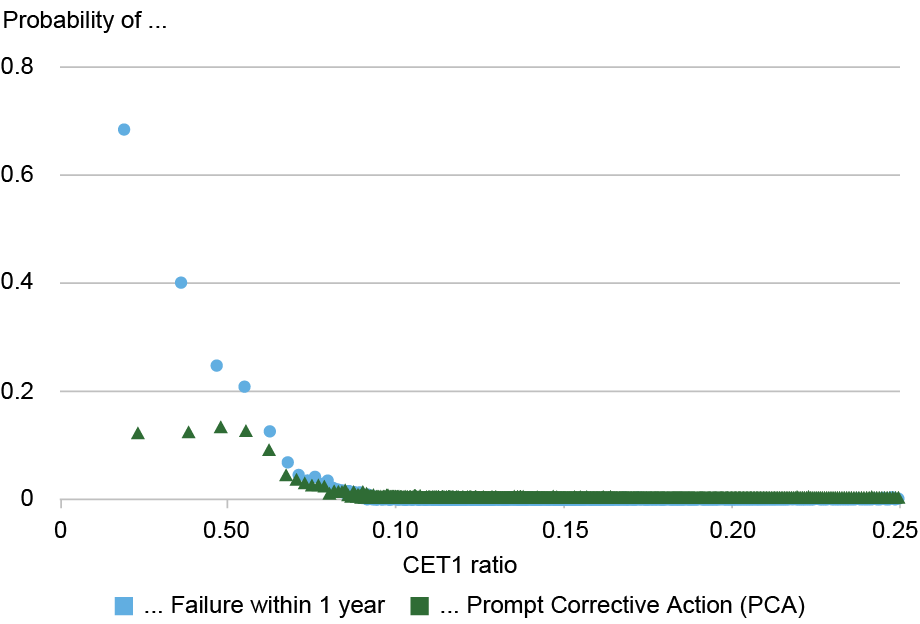
Notes: This chart shows a binned scatterplot of the probability that a bank fails or is subject to prompt-corrective action (PCA) over the next year as a function of the CET1 ratio. We use the sample of all banks between 2000 and 2023 but restrict the sample to banks with a CET1 ratio of less than 25% to facilitate the visualization. The CET1 ratio is based on common equity tier 1 capital relative to risk-weighted assets. We select the MSE-optimal bins and each bin contains around 400 bank-quarter observations.
We also correlate Supervisory CAMELS ratings with a bank’s equity to assets ratio. CAMELS ratings assess a bank’s financial health based on six criteria: capital, assets, management, earnings, liquidity, and sensitivity to market risk.
The blue markers in the chart below suggest a tight relation between a bank’s reported book equity and the supervisory composite CAMELS ratings, indicating that downgrades follow or coincide with a noticeable deterioration in a bank’s financial statements. For instance, banks with an equity-to-assets ratio of above 7.5 percent are typically rated as 1 (“Strong”) or 2 (“Satisfactory”), with the average rating being around 1.8. However, for less well-capitalized banks, the CAMELS rating is both higher and more sensitive to bank book equity. Banks with an equity-to-assets ratio of less than 4 percent are almost always rated with a 4 (“Deficient”) or even 5 (“Critically Deficient”), and the average rating is well above 4. This pattern suggests that the composite CAMELS rating closely tracks verifiable hard information on a bank’s capitalization for poorly capitalized banks.
This notion that CAMELS ratings for distressed banks are closely related to hard information is reinforced by contrasting different sub-components of the CAMELS rating. The chart below also plots the ratings for management and capital, which are inputs into the composite CAMELS rating. We focus on these two sub-components because, while the capital rating is mechanically related to the observed capitalization, the management rating naturally allows for supervisory discretion. While the composite rating essentially coincides with the average capital rating for low capitalization, it systematically deviates and exceeds the capital rating for well capitalized banks. For well capitalized banks, the composite rating is much closer to the management rating, in line with supervisors exercising discretion for banks that are not in distress.
CAMELS Ratings and Regulatory Capital
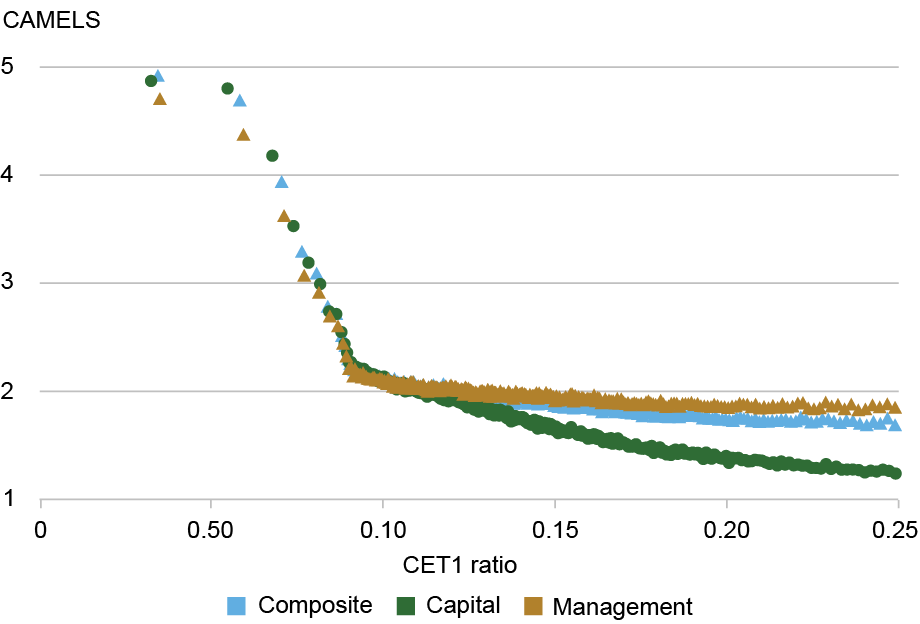
Notes: This chart shows a binned scatterplot of the highest CAMELS rating observed over the next year against the common equity tier 1 ratio (CET1 ratio). We combine binned scatterplots for the composite rating, the capital rating, and the management rating. We use the sample of all banks between 2000 and 2023 but restrict the sample to banks with a CET1 ratio of less than 25% to facilitate the visualization. The CET1 ratio is based on common equity tier 1 capital relative to risk-weighted assets. We select the MSE-optimal bins and each bin contains around 400 bank-quarter observations.
Supervisors Shape Hard Information
We next document that supervisors take an active role in shaping the hard information on bank capitalization available in the public financial statements of banks through on-site examinations, suggesting that CAMELS ratings and bank capitalization are jointly determined in distressed banks.
We study the revisions of previously submitted financial statements to understand both the role of banks’ discretion in their financial reporting and the potential role of bank supervision in shaping such financial statements. The chart below plots the probability of revising a previously submitted call report for the six-month window around an on-site examination. We find that the probability of revising a previously submitted call report increases slightly in the two months before an examination and then shoots up sharply in the month of and two months right after an examination. This pattern suggests that the examination itself is associated with a much higher propensity of revising original submission.
Revisions of Previously Submitted Call Reports Around On-Site Examinations
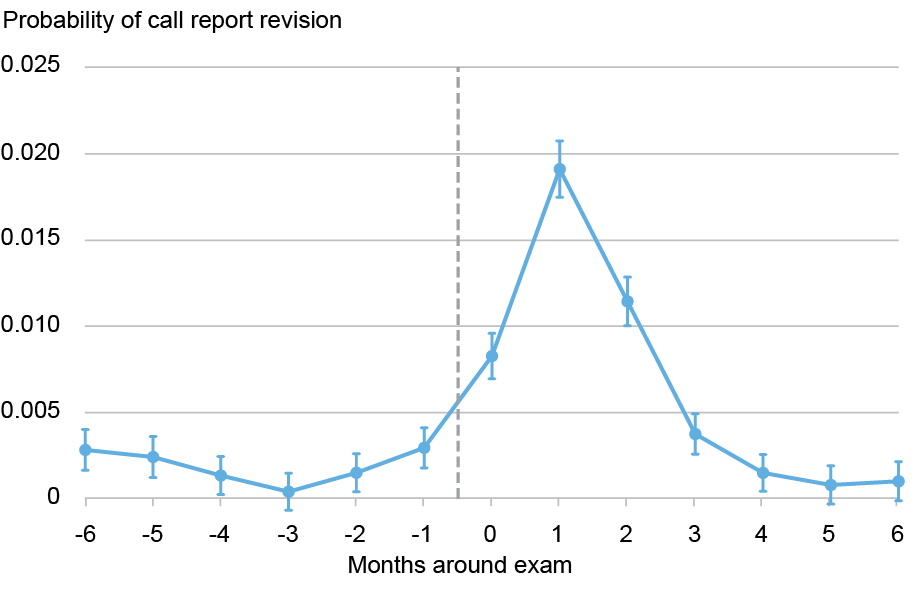
Notes: This chart presents the sequence of coefficients from an indicator for whether bank revises either its net income or book equity (from a Call Report submitted before) on dummies that whether a bank was subject to an examination that started in month t=0. The regression also contains a set of bank fixed effects, and a set of calendar-month fixed effects. The sample is restricted to all commercial banks and to 2007-23. Standard errors are clustered at the bank level. Error bars represent 95% confidence intervals.
In our paper, we further show that, while the difference in the revisions is small after any given exam, the cumulative revisions are large for failing banks. In the five years before it fails, a typical failing bank will experience an 8 percentage point decline in its equity‑to‑assets ratio, with revisions amounting to nearly 3 percentage points of this decline. Thus, a considerable part of the decline in the equity‑to‑assets ratio in failing banks occurs after revisions of their original call report submissions.
The Trade-Off between Strictness and Forbearance
In our paper, we further analyze a natural experiment during the 2008 Global Financial Crisis (GFC) in which otherwise similar banks were quasi-randomly assigned strict supervisors. In this context, we define a “stricter” supervisor as someone who assigns a worse CAMELS rating for the same underlying financial condition.
We find that stricter supervision caused banks to recognize more losses and report lower book equity, leading to an increased likelihood of failure. Elevated strictness lowered the cost of failures for the FDIC but also led to reduced credit in the short term. Thus, our findings highlight an important tradeoff between strictness and forbearance. Stricter supervision can reduce the scope for gambling for resurrection that increases eventual resolution costs or sustains zombie banks that misallocate credit. However, loss recognition and bank closures may come at the cost of tightening credit supply precisely when credit conditions are already weak. Alternatively, supervisors can engage in optimal forbearance. Forbearance may preserve credit supply and enable banks to recover if asset values improve. These trade-offs are especially salient with deposit insurance, which weakens market discipline.
Wrapping Up
We show that the disciplining function of supervision operates through both supervisory actions based on hard information as well as the production of hard information. Supervisory strictness in failing banks operates primarily on the production of hard information, which, in turn, determines whether troubled banks are closed. However, while our empirical setting enables us to pinpoint the key trade-off between stricter supervision and lower credit supply, our analysis is entirely positive, and we do not draw normative conclusions about the optimal degree of banking supervisory strictness.

Sergio Correia is a senior economist at the Federal Reserve Bank of Richmond.

Stephan Luck is a financial research advisor in the Federal Reserve Bank of New York’s Research and Statistics Group.
Emil Verner is the Lemelson Professor of Management and Financial Economics and a professor of finance at MIT Sloan School of Management.
How to cite this post:
Sergio Correia, Stephan Luck, and Emil Verner, “How Do Banking Supervisors Deal with Failing Banks?,” Federal Reserve Bank of New York Liberty Street Economics, November 2, 2026, https://doi.org/10.59576/lse.20261102
BibTeX: View |


Disclaimer
The views expressed in this post are those of the author(s) and do not necessarily reflect the position of the Federal Reserve Bank of New York or the Federal Reserve System. Any errors or omissions are the responsibility of the author(s).
 You can follow this conversation by subscribing to the comment feed for this post.
 RSS Feed
 Follow Liberty Street Economics