










393 posts on "Liberty Street Economics"
March 24, 2021
Did Dealers Fail to Make Markets during the Pandemic?
Sarkar and coauthors liquidity provision by dealers in several important financial markets during the COVID-19 pandemic: how much was provided, possible causes of any shortfalls, and the effects of the Federal Reserve’s actions to support the economy.
March 19, 2021
Looking Back at 10 Years of Liberty Street Economics
This month the Liberty Street Economics blog is celebrating its tenth anniversary. We first welcomed readers to Liberty Street on March 21, 2011 and since then our annual page views have grown from just over 260,000 to more than 3.3 million.
February 11, 2021
Did Subsidies to Too‑Big‑To‑Fail Banks Increase during the COVID‑19 Pandemic?

New Liberty Street Economics analysis by Asani Sarkar investigates whether the COVID-19 pandemic has led to an increase in implicit TBTF subsidies for large firms.
Posted at 7:00 am in Banks, Financial Institutions, Pandemic, Systemic Risk | Permalink | Comments (2)
February 9, 2021
Black and White Differences in the Labor Market Recovery from COVID‑19
The ongoing COVID-19 pandemic and the various measures put in place to contain it caused a rapid deterioration in labor market conditions for many workers and plunged the nation into recession. The unemployment rate increased dramatically during the COVID recession, rising from 3.5 percent in February to 14.8 percent in April, accompanied by an almost three percentage point decline in labor force participation. While the subsequent labor market recovery in the aggregate has exceeded even some of the most optimistic scenarios put forth soon after this dramatic rise, this recovery has been markedly weaker for the Black population. In this post, we document several striking differences in labor market outcomes by race and use Current Population Survey (CPS) data to better understand them.
Posted at 11:00 am in Demographics, Equitable Growth, Human Capital, Inequality, Labor Market, Pandemic, Recession, Unemployment | Permalink
Some Workers Have Been Hit Much Harder than Others by the Pandemic
Abel and Deitz look at the outsized impact of the COVID-19 pandemic on some workers, particularly those who are in lower-wage jobs, without a college degree, female, minority, and younger.
Posted at 11:00 am in Demographics, Employment, Equitable Growth, Inequality, Labor Market, Pandemic, Unemployment | Permalink | Comments (1)
January 12, 2021
Understanding the Racial and Income Gap in COVID‑19: Social Distancing, Pollution, and Demographics
Chakrabarti, Pinkovskiy, and coauthors investigate the extent to which age, pollution, and social distancing factor in to the income and racial gaps in COVID-19 incidence.
January 6, 2021
The International Spillover of U.S. Monetary Policy via Global Production Linkages

Julian di Giovanni describes work with Galina Hale that employs an empirical framework to quantify the role of the global production network in transmitting U.S. monetary policy across international stock markets.
Posted at 7:00 am in Bank Capital, Banks, Exports, Financial Markets, International Economics, Monetary Policy, Stocks, Tariffs | Permalink
December 23, 2020
Understanding the Impact of COVID‑19: The Top Five LSE Posts of 2020
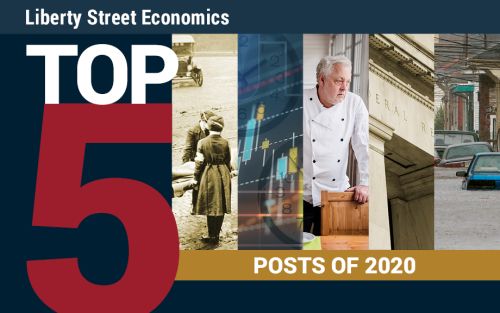
An annual tradition at Liberty Street Economics is to present our most-read posts of the year. Given the events of 2020, New York Fed economists and guest coauthors focused their analysis on the effects of the coronavirus pandemic, writing some seventy articles since March on the subject. Our leading posts, in terms of traffic, all touch on the theme in some way. Consider this space a hub for COVID-19 coverage for some time to come, and take a look back at the top five posts grabbing attention in 2020.
October 15, 2020
COVID‑19 Has Temporarily Supercharged China’s Export Machine
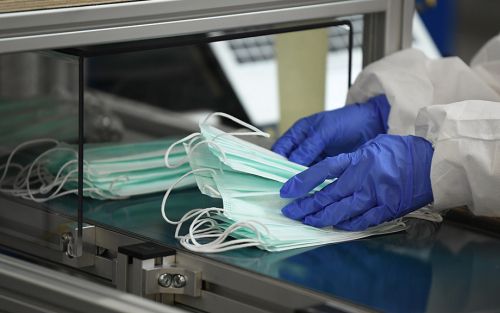
Hunter Clark takes a look at China’s export performance for 2020, which has been stronger than expected owing to an export structure well-positioned for the COVID-19 crisis.
September 28, 2020
COVID‑19 and the Search for Digital Alternatives to Cash

This analysis presents evidence on the impact of COVID-19 on consumer payment behavior, finding acceleration in the use of digital payment technology.
 RSS Feed
 Follow Liberty Street Economics
