










158 posts on "Labor Market"
November 14, 2018
Just Released: New York State’s Community Colleges are Successfully Partnering with Employers
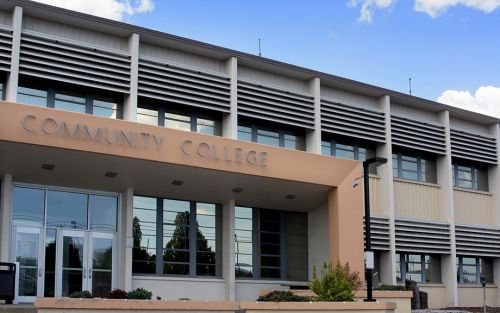
Community colleges frequently work with local employers to help shape the training of students and incumbent workers. This type of engagement has become an increasingly important strategy for community colleges to help students acquire the right skills for available jobs, and also helps local employers find and retain workers with the training they need. The Federal Reserve Bank of New York conducted a survey of community colleges in New York State with the goal of documenting the amount and types of these kinds of activities taking place. Our report, Employer Engagement by Community Colleges in New York State, summarizes the findings of our survey.
Posted at 12:00 pm in Education, Human Capital, Labor Market, New York, Regional Analysis | Permalink
September 28, 2018
Just Released: Are Employer‑to‑Employer Transitions Yielding Wage Growth? It Depends on the Worker’s Level of Education

The rate of employer-to-employer transitions and the average wage of full-time offers rose compared with a year ago, according to the Federal Reserve Bank of New York’s July 2018 SCE Labor Market Survey. Workers’ satisfaction with their promotion opportunities improved since July 2017, while their satisfaction with wage compensation retreated slightly. Regarding expectations, the average expected wage offer (conditional on receiving one) and the reservation wage—the lowest wage at which respondents would be willing to accept a new job—both increased. The expected likelihood of moving into unemployment over the next four months showed a small uptick, which was most pronounced for female respondents.
September 10, 2018
Whither Labor Force Participation?

Halting a nearly decade-long downward trend, the U.S. labor force participation rate (LFPR) has flattened since 2016, fluctuating within a narrow range a little below 63 percent. What role has the economy played in this change and what can we expect for the future? In this post, we investigate the extent to which the recent flattening of participation can be attributed to the simultaneous robust improvement in the labor market. We also assess the future path of participation in the medium run should labor market conditions improve further.
September 5, 2018
Education’s Role in Earnings, Employment, and Economic Mobility

Amid dialogue about the soaring student loan burden, questions arise about how educational characteristics (school type, selectivity, and major) affect disparities in post-college labor market outcomes. In this post, we specifically explore the impact of such school and major choices on employment, earnings, and upward economic mobility. Insight into determinants of economic disparity is key for understanding long-term consumption and inequality patterns. In addition, this gives us a window into factors that could be used to ameliorate income inequality and promote economic mobility.
Posted at 7:00 am in Education, Equitable Growth, Human Capital, Inequality, Labor Market | Permalink
April 4, 2018
Do the Employed Get Better Job Offers?

In a previous post, we examined the job search behavior of workers, both on the job and while unemployed. We found that job seeking is pervasive among employed workers, and that searching while employed is more effective than searching while unemployed in producing employer contacts and job offers. But how do the offers received through “on the job” search compare to those received while unemployed? What do their wages look like, how do they compare in terms of nonwage benefits, and how much bargaining between employers and job applicants is involved? In this post, we shed some light on how job offers may vary depending on the employment status of the job seeker.
March 28, 2018
Do Expansions in Health Insurance Affect Student Loan Outcomes?

The Patient Protection and Affordable Care Act (ACA) is arguably the biggest policy intervention in health insurance in the United States since the passage of Medicaid and Medicare in 1965. The Act was signed into law in March 2010, and by 2016 approximately 20 to 24 million additional Americans were covered with health insurance. Such an extension of insurance coverage could affect not only medical bills, but also educational, employment, and broader financial outcomes. In this post, we take an initial look at the relationship between the ACA and higher education financing choices and outcomes. We find evidence that expansions in healthcare coverage may influence both the prevalence of student loans and loan repayment behavior. The evidence suggests that individuals covered by ACA-related expansions are taking out slightly more loans and taking a longer time to start repayment.
October 13, 2017
Upstate New York’s Expansion Is Losing Steam

All in all, the upstate New York economy fared pretty well during the last business cycle.
October 5, 2017
How Is Online Shopping Affecting Retail Employment?

It’s been said that if you want to know how the economy is doing, look at how many people are carrying shopping bags. That adage may not hold so well today. The rise of the internet and e-commerce over the past two decades has chipped away at the market share of “brick and mortar” retailers.
August 21, 2017
Just Released: Introducing the SCE Labor Market Survey

The New York Fed has just released new data on individuals’ experiences and expectations in the labor market. These data have been collected every four months since March 2014 as part of the Survey of Consumer Expectations (SCE). In this post we introduce the SCE Labor Market Survey and highlight some of its features.
August 10, 2017
Just Released: Economic Press Briefing Focuses on Regional Wage Inequality
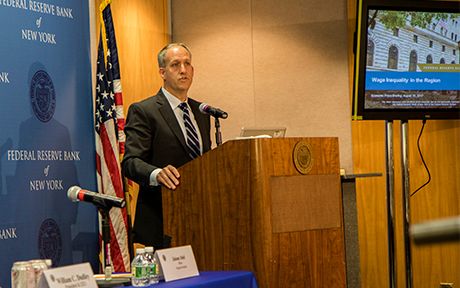
The New York-Northern New Jersey region is home to some of the most and least unequal places in the nation, based on research presented today at our economic press briefing examining wage inequality in the region. Wage inequality—meaning the disparity in earnings between workers—has increased significantly in the United States since the early 1980s, though some places have much more wage inequality than others. Fairfield, Conn., for example, ranks as the most unequal metropolitan area in the country, and the New York–Northern New Jersey metropolitan area ranks in the top ten. On the other hand, most of the metropolitan areas in upstate New York are among the least unequal places in the country.
 RSS Feed
 Follow Liberty Street Economics
