










258 posts on "Macroeconomics"
June 19, 2020
The New York Fed DSGE Model Forecast—June 2020
This post presents an update of the economic forecasts generated by the Federal Reserve Bank of New York’s dynamic stochastic general equilibrium (DSGE) model. As usual, we wish to remind our readers that the DSGE model forecast is not an official New York Fed forecast, but only an input to the Research staff’s overall forecasting process. For more information about the model and variables discussed here, see our DSGE model Q & A.
The New York Fed DSGE Model Forecast—March 2020
This post presents an update of the economic forecasts generated by the Federal Reserve Bank of New York’s dynamic stochastic general equilibrium (DSGE) model. We describe very briefly our forecast and its change since December 2019. As usual, we wish to remind our readers that the DSGE model forecast is not an official New York Fed forecast, but only an input to the Research staff’s overall forecasting process. For more information about the model and variables discussed here, see our DSGE model Q & A.
May 28, 2020
The Investment Cost of the U.S.‑China Trade War

Starting in early 2018, the U.S. government imposed tariffs on over $300 billion of U.S. imports from China, increasing the average tariff rate from 2.7 percent to 17.5 percent. Much of the escalation in tariffs occurred in the second and third quarters of 2019. In response, the Chinese government retaliated, increasing the average tariff applied on U.S. exports from 5.7 percent to 20.4 percent. Our new study finds that the trade war reduced U.S. investment growth by 0.3 percentage points by the end of 2019, and is expected to shave another 1.6 percentage points off of investment growth by the end of 2020. In this post, we review our study of the trade war’s effect on U.S. investment.
May 18, 2020
Modeling the Global Effects of the COVID‑19 Sudden Stop in Capital Flows
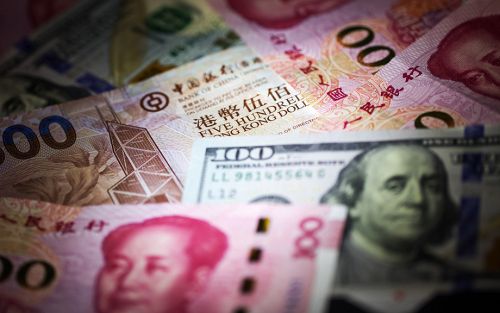
The COVID-19 outbreak has triggered unusually fast outflows of dollar funding from emerging market economies (EMEs). These outflows are known as “sudden stop” episodes, and they are typically followed by economic contractions. In this post, we assess the macroeconomic effects of the COVID-induced sudden stop of capital flows to EMEs, using our open-economy DSGE model. Unlike existing frameworks, such as the Federal Reserve Board’s SIGMA model, our model features both domestic and international financial constraints, making it well-suited to capture the effects of an outflow of dollar funding. The model predicts output losses in EMEs due in part to the adverse effect of local currency depreciation on private-sector balance sheets with dollar debts. The financial stresses in EMEs, in turn, spill back to the U.S. economy, through both trade and financial channels. The model-predicted output losses are persistent (consistent with previous sudden stop episodes), with financial effects being a significant drag on the recovery. We stress that we are only tracing out the effects of one particular channel (the stop of capital flows and its associated effect on funding costs) and not the totality of COVID-related effects.
Posted at 7:00 am in Crisis, Exchange Rates, International Economics, Macroeconomics, Pandemic | Permalink | Comments (2)
May 14, 2020
Putting the Current Oil Price Collapse into Historical Perspective

Since the outbreak of the COVID-19 pandemic in late January, oil prices have fallen sharply. In this post, we compare recent price declines with those seen in previous oil price collapses, focusing on the drivers of such episodes. In order to do that, we break oil price shocks down into demand and supply components, applying the methodology behind the New York Fed’s weekly Oil Price Dynamics Report.
Posted at 7:00 am in Financial Markets, International Economics, Macroeconomics, Pandemic | Permalink
May 4, 2020
W(h)ither U.S. Crude Oil Production?

The rapid increase in U.S. oil production of recent years was looking difficult to sustain before the pandemic, as evidenced by the limited profitability of the sector. Now, U.S. producers may have to bear the brunt of the global supply adjustment needed over the near term.
March 30, 2020
Monitoring Real Activity in Real Time: The Weekly Economic Index

New Weekly Economic Index sheds light on the high-frequency evolution of the economy in real time.
February 24, 2020
Understanding Heterogeneous Agent New Keynesian Models: Insights from a PRANK

To shed light on the macroeconomic consequences of heterogeneity, Acharya and Dogra develop a stylized HANK model that contains key features present in more complicated HANK models.
Posted at 7:00 am in Central Bank, Credit, Federal Reserve, Financial Institutions, Fiscal Policy, Inequality, Macroeconomics, Monetary Policy, Recession, Systemic Risk | Permalink
February 13, 2020
Firm‑Level Shocks and GDP Growth: The Case of Boeing’s 737 MAX Production Pause

Events specific to large firms can have significant effects on the macroeconomy. The recent pause in Boeing’s 737 MAX production is a striking example of such an event or “shock.” This post provides a back-of-the envelope calculation of how the “737 MAX shock” could impact U.S. GDP growth in the first quarter of 2020.
Posted at 7:00 am in Macroeconomics | Permalink
February 12, 2020
Reading the Tea Leaves of the U.S. Business Cycle—Part Two

New work by Richard Crump, Domenico Giannone, and David Lucca finds labor market data to be the most reliable information for dating the U.S. business cycle.
Posted at 7:00 am in Labor Market, Macroeconomics, Recession, Unemployment | Permalink | Comments (1)
 RSS Feed
 Follow Liberty Street Economics
